

What changes when you own the home but live somewhere else
Three things change. You cannot walk over and look, you learn about problems through someone else, and the rules depend on the city and on when the home was built. None of that is a reason to hold fewer homes. It is a reason to decide the routine ahead of time instead of during a repair.
The home is only seen when someone is sent. Every update reaches you through a message, a statement or a portal, so what you get depends on what was agreed. And statewide rent cap and just-cause rules (AB 1482, the California Tenant Protection Act) cover many single-family homes, while some cities add their own rules. Our California landlord laws guide tracks what applies, and it changes every year.
What to ask for in writing
Put each item in the management agreement, or in a written reply, before you sign. Croskey's own answers come from its pricing page and process page.
| What you need when you cannot be there | What to ask for in writing | What Croskey publishes today |
|---|---|---|
| One view of all your homes | One statement that covers every property, with every dollar itemized | An itemized monthly statement showing every dollar, and one monthly statement regardless of how many properties you own |
| Year-end numbers for your accountant | Who prepares the year-end owner statement and the tax forms | Year-end owner statement and 1099 processing, plus a year-end cash-flow summary |
| Control over spending | A repair approval limit for each property, and what happens above it | Limits set per property in the signed management agreement. Repairs above the approved threshold are pre-authorized before work begins |
| Clean vendor billing | Invoices at their original amounts, with photos of the completed work | The vendor invoice pays the vendor. No markup on routine invoices. Photo-documented repair billing |
| Eyes on the home | How often someone walks the home, and where the report goes | An annual walkthrough with photos on the Core plan, semiannual assessments on the upper plans, report stored in your owner portal |
| Speed on repairs | How fast a request is acknowledged, and how emergencies are handled | Routine requests acknowledged within one business day. Emergencies handled the same day, with 24-hour contact availability |
| Move-outs | How and when you hear that a resident gave notice, and what happens next | A pre-move-out inspection offered in the final two weeks, and the deposit refund or itemized statement within the 21 calendar days California requires |
One statement for every home
A monthly statement is useful only if you can read it in a few minutes and trust it. For each home it should show the rent that came in, the fees that came out, each repair bill with its date, and what reached your bank account.
Every home you own goes on one monthly statement with us, however many that is. Three homes on one page are faster to read than three separate statements, and a line that looks wrong stands out when the others sit beside it. One team in our Pittsburg office runs all of them, so a question about any home goes to the same people.
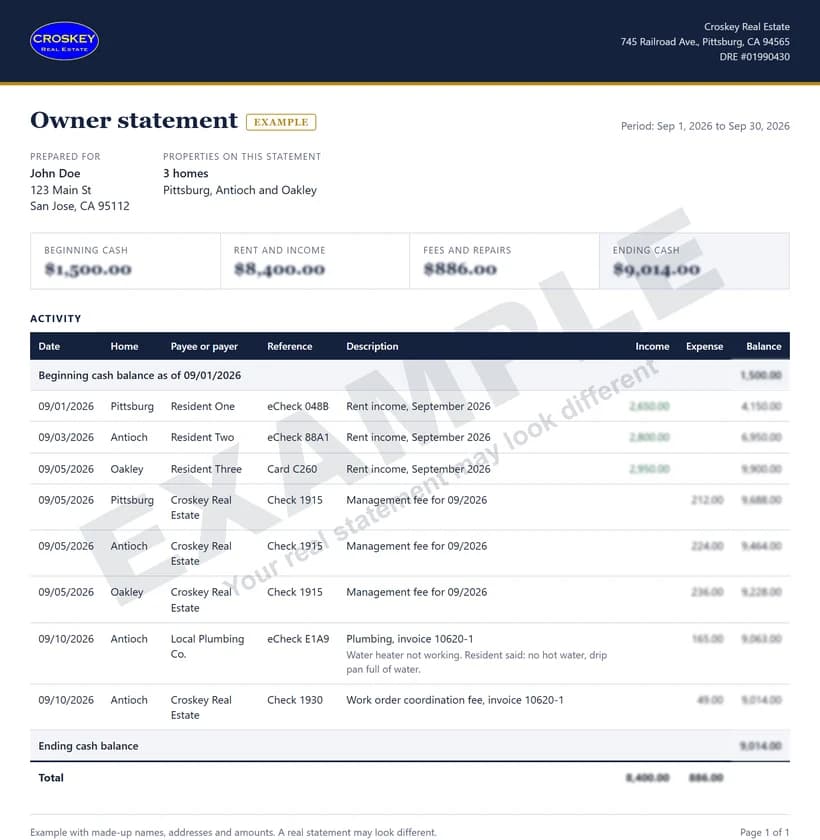
As a Croskey owner, you can pick one day each month to sit down with your statement, and the easiest one is the day it arrives. If a line surprises you, ask us that same week, because the repair behind it is still fresh. On routine repairs we review the invoice and the completion evidence and keep the outcome in the property's record, so a question about last month's work can be answered from the work order, the photos and the invoice together.
At year end you need numbers your accountant can use. The year-end owner statement and 1099 processing are listed on the pricing page for that reason. Ask for them in the agreement, not in January.
Repair limits and vendor bills when you cannot go look
The repair approval limit is the amount a manager can spend on a repair without asking you first. Above it, you decide. At Croskey the limit is set for each property in the signed management agreement, and repairs above the approved threshold are pre-authorized before work begins.
Set it per property, not once for everything. A home built in the 1960s with its original water heater and a home with a newer roof and a replaced furnace will not need the same number. Revisit it once a year, when the annual walkthrough report arrives.
On billing, ask for three things: the vendor's original invoice, photos of the finished work, and the date it was paid. At Croskey the vendor invoice pays the vendor, and routine invoices carry no markup. Croskey is paid through fees disclosed on its pricing page, not through markups on invoices. Our post on whether a property manager can charge for maintenance walks through how to read this on a statement.
If a vendor ever tells you they have not been paid, ask your manager for the invoice, the payment date and the work order photos. A matched record answers that question in one email, and it is also a good test of how a manager keeps records.
Move-outs when you are not there
A move-out is the moment a remote owner feels the distance most, because keys, inspection and deposit all move on a short clock. The law sets the clock. The itemized statement and any refund are due no later than 21 calendar days after the resident vacates, and the housing provider must photograph the unit after possession is returned and again after any repair or cleaning that will be deducted (Civil Code section 1950.5, subdivisions (g) and (h)).
Our move-in and move-out inspections guide covers the full sequence, including the initial inspection. For a remote owner the practical step is simple. Ask your manager, in writing, how you will hear that a resident has given notice and who will tell you the inspection date. Croskey's published steps are on the process page.
When you add the next home
Adding a home should not mean starting over. Owners do take that path. As of October 21, 2026, 18 of the 99 owners with an active home under our management hold two or more homes with us, and 11 hold three or more (source: Croskey's AppFolio owner directory). If the next house is in East Contra Costa, it joins the same monthly statement and the same owner portal, and you set its repair limit on its own terms. Croskey is also a licensed California brokerage (DRE, the California Department of Real Estate, license number 01990430), so help with buying or selling is available as your holdings change. The investors page lists how that works.
Check insurance when the count goes up. Our landlord insurance guide explains why a second or third home is a good time to review coverage.
Owners who would rather run a home themselves after a resident is placed have a separate path, lease-only placement. Our guide on whether a property manager is worth it compares the two.
Our read, from the operator's chair
A resident reports that the heater has stopped working. The request is logged, someone checks the property's repair history, dispatches a vendor, arranges access, reviews the invoice and the completion photos, and confirms with the resident that the heat is back. An owner in another city sees none of it happen.
From where we sit, the owner's one job in that sequence happens months earlier: deciding the limit. A limit that is too low sends small repairs to your phone while you are at work. A limit that is too high lets a bigger decision happen without you. So we would rather an owner set the number thoughtfully on day one for each home, and look at it again every year, than sign a default and forget it. The statement, the photos and the portal are there to confirm that the routine you chose is the routine that ran.
If you own two to ten homes in East Contra Costa and live somewhere else, Get a landlord consultation and bring your current statements. The seven things to get in writing make a good agenda for that call.
General information, not legal, tax or insurance advice. Confirm the rules that apply to your property with your own advisors. Croskey Real Estate, DRE #01990430. Equal Housing Opportunity.
Frequently asked questions
Can I own rentals in East Contra Costa and live in another Bay Area city?
Many Croskey owners do not live near their rentals. A local team handles the work on the ground, and you see statements, payments and documents through a digital owner portal. The setup works best when the routine is agreed in writing before you sign: one statement for all your homes, a repair approval limit for each property, and a clear process for move-outs.
Will I get one statement if I own several homes?
Croskey sends one monthly statement regardless of how many properties an owner has. One team in the Pittsburg office runs every home, so a question about any of them goes to the same people. The statement is itemized so every dollar can be traced, and a year-end owner statement and 1099 processing are listed on the pricing page for your accountant.
Who approves repairs when I am not around?
Your repair approval limit is set for each property in the signed management agreement. Repairs above the approved threshold are pre-authorized before work begins, so larger decisions come to you first. Emergencies are handled the same day, with 24-hour contact availability.
How long does a security deposit refund take after a resident moves out?
California requires the housing provider to send an itemized statement and any refund no later than 21 calendar days after the resident vacates (Civil Code section 1950.5). Photographs of the unit are required after possession is returned and again after any repair or cleaning that will be deducted.
Sources
Keep reading
SB 721 Balcony Inspections in 2026: What Owners of 3+ Unit Buildings Need to Know Now
Aug 3, 2026
California security deposit rules in 2026: the one-month cap, the photographs, the 21 days and the electronic refund
Jul 31, 2026

Can Property Management Companies Charge for Maintenance? (California Guide)
May 8, 2026