
California housing providers must notify a resident in writing, once either side gives notice to end the tenancy, that the resident may request an initial inspection before moving out and may be present for it. If the resident is offered one and does not request it, the duties under that part of the statute are discharged. Everything else still applies: the photographs, the itemized statement and the deposit deadline.
That is the legal spine, and around it sits one timing decision most owners never notice until the deposit is already short.
It works the same way whether you manage the property yourself or someone manages it for you. If you have a manager, this is what you should expect them to be doing on your behalf.
The process at a glance
| Stage | What California requires |
|---|---|
| Move-in | A documented baseline inspection; for newer tenancies, move-in photographs are part of the record |
| Notice to end the tenancy | The housing provider must tell the resident, in writing, that they may request an initial inspection and be present for it |
| Initial inspection (if requested) | No earlier than two weeks before the end date, with at least 48 hours prior written notice either way |
| After the initial inspection | An itemized statement of the proposed deductions, handed to the resident or left inside the premises |
| Final inspection | After possession is returned; photographs are mandatory, taken before and after any work that will be deducted |
| Deposit settlement | The itemized statement and any refund are due within 21 days of move-out; ordinary wear and tear is never deductible (see the security deposit guide) |
Every row traces to Civil Code section 1950.5.
The move-in and move-out checklist
Whether you run the inspection yourself or a manager runs it for you, the walk-through covers the same ground every time:
- Exterior and landscaping
- Flooring, walls, ceilings, doors and trim
- Windows and screens
- Appliances and plumbing fixtures
- Cabinets, counters and bathrooms
- Smoke and carbon monoxide alarms
- Keys and access devices
- Overall cleanliness, and any visible safety or habitability concern
Download the printable move-in / move-out checklist (PDF), the room-by-room form we use, and keep the completed copy together with the photographs: that pair is the baseline every later deduction is measured against. Croskey residents have their own operational page for utilities and turnover steps: the resident checklist.
The question every deposit dispute turns on
Was the condition already like that, or did it happen during the tenancy?
Almost every disagreement over a security deposit reduces to that one question. The inspection process exists to answer it with evidence rather than memory, which is why the documentation matters more than any individual walkthrough.
A complete condition record covers the property at move-in, what the resident reported early on, what broke during occupancy, what was repaired, the condition before the resident left, and the condition after possession came back.
That record gets built step by step through the rest of the process. Once it exists, what may lawfully be deducted, the itemization requirements and the return deadline are the other half of the story, and our California security deposit guide walks that half in the same depth.
What getting this wrong costs
Under section 1950.5(m), the bad faith claim or retention of a deposit can expose an owner to statutory damages of up to twice the amount of the security, in addition to actual damages. The same subdivision provides that a court may award those damages whenever the facts warrant it, whether or not the resident specifically asked for them.
On a one month deposit, that turns a disputed few hundred dollars of cleaning into a four figure exposure before the underlying claim is even valued. It is why the paperwork below is worth doing properly on small amounts, not only on large ones.
Move-in documentation: the baseline
The move-in inspection documents the home before the resident has lived in it. A useful report covers the exterior and landscaping, flooring, walls, ceilings, doors and trim, windows and screens, appliances, plumbing fixtures, cabinets and counters, bathrooms, smoke and carbon monoxide alarms, keys and access devices, cleanliness, and any visible safety or habitability concern.
Photographs are now part of this for newer tenancies. Under Civil Code section 1950.5(g)(1), for tenancies beginning on or after July 1, 2025, the housing provider must take photographs of the unit immediately before, or at the start of, the tenancy. Tenancies that began before that date are not covered by the statutory requirement, though the same photographs remain the most useful evidence an owner can hold.
Residents should document independently as well. A manager's report is thorough, but a resident who photographs a scratched cabinet, a stained drawer, a torn screen or a missing garage remote in the first week has protected themselves from being charged for it two years later. Both records point the same direction, which is exactly the point.
During the tenancy: maintenance records tell the story
Move-in and move-out are the bookends. What happens between them is often what decides a dispute.
When a resident reports a leak, a failed appliance, a pest issue or a broken fence, that work order becomes part of the condition record: when it was reported, what the vendor found, whether it was completed, and whether the cause was age, failure, accident or misuse. An owner with a clean maintenance history rarely argues about what happened, because the file already says.
Move-out begins: written notice and the right to request an inspection
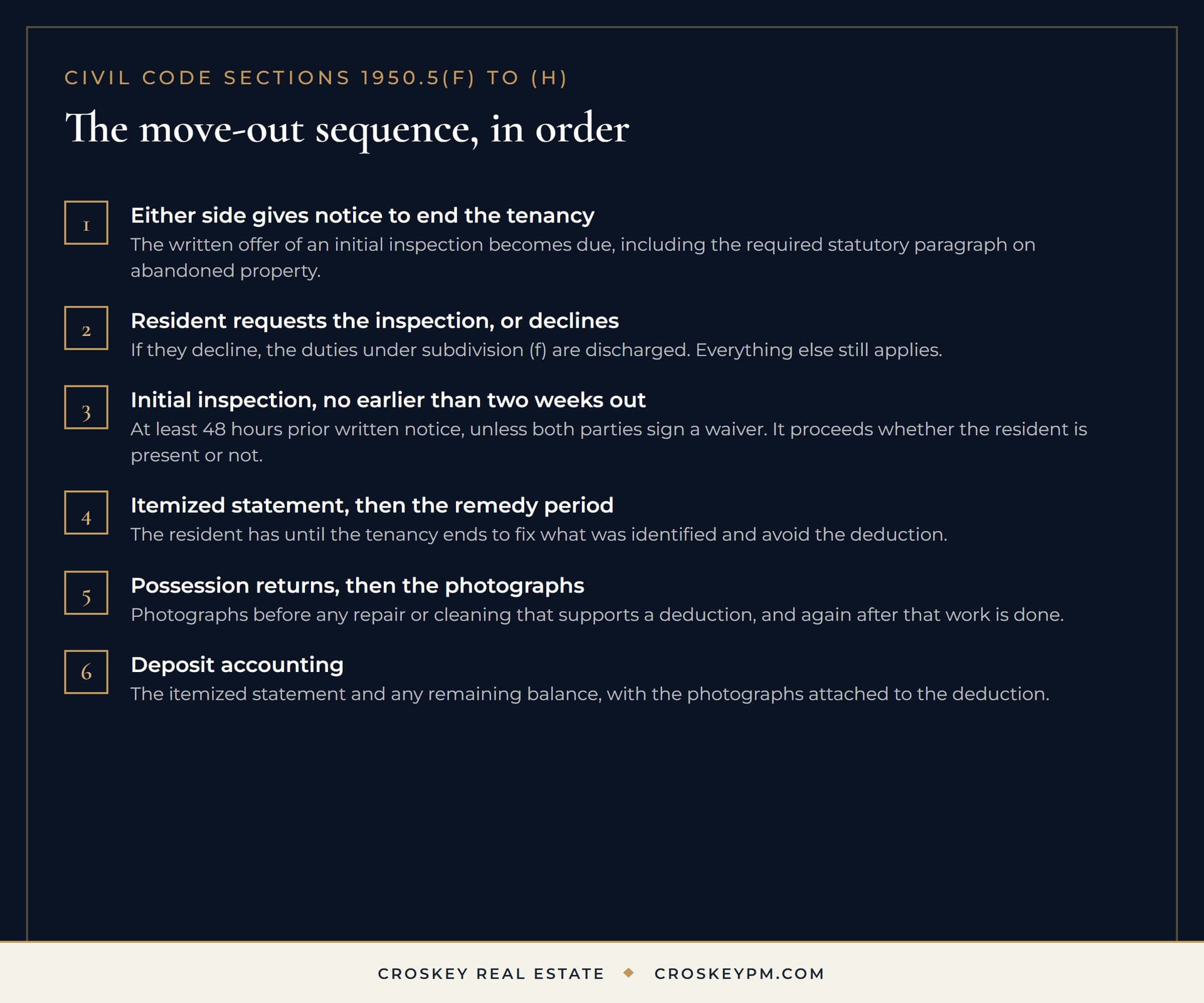
Once either party gives notice to terminate, or the lease term is approaching its end, Civil Code section 1950.5(f)(1) requires the housing provider to notify the resident in writing of two things: the option to request an initial inspection, and the right to be present for it.
This is an obligation, not a courtesy. Two details are easy to miss.
The notice must contain specific statutory language. Section 1950.5(f)(1) requires the written notice to include, in substantially the same form, a paragraph explaining that former tenants may reclaim abandoned personal property left behind, that costs may apply, and that those costs are generally lower the sooner the former housing provider is contacted. A move-out packet without that paragraph does not satisfy the statute.
The requirement does not apply to every termination. Section 1950.5(f)(7) exempts tenancies terminated under Code of Civil Procedure section 1161, subdivisions (2), (3) and (4), which cover nonpayment of rent, breach of a lease covenant, and nuisance, waste or unlawful use. In those situations the initial inspection obligation does not attach.
If the resident does not request the inspection, the duties under this subdivision are discharged.
That is not a summary of the law. It is the fourth sentence of Civil Code section 1950.5(f)(1), which reads, in full: "If a tenant chooses not to request an initial inspection, the duties of the housing provider (landlord) under this subdivision are discharged."
It resolves a question many managers worry about. Residents frequently decline, often because they are mid-move and see it as one more appointment. Declining does not create exposure for the owner. What creates exposure is never having made the written offer, or not being able to show that it was made.
Two limits on that sentence matter more than the sentence itself.
It discharges only the initial inspection duties. Section 1950.5 runs from subdivision (a) through (r), and the initial inspection lives in subdivision (f). A resident declining it has no effect on the photograph requirements in subdivision (g), the itemized statement and deposit deadline in subdivision (h), the limits on what may be claimed in subdivision (e), or the bad faith exposure in subdivision (m). All of those continue exactly as before.
It follows the notice, it does not replace it. A resident can only choose not to request an inspection they were told about. The discharge describes what happens after a proper written offer is declined. It is not a reason to skip the offer.
The initial inspection: what it is and what it is not
The initial inspection is sometimes called the pre move-out inspection. It is not the final inspection. Its statutory purpose is to give the resident a chance to fix identified problems before the deposit is settled.
If the resident requests it, the inspection happens at a reasonable time but no earlier than two weeks before the termination or lease end date. The parties are to attempt to schedule at a mutually acceptable date and time.
The 48 hour written notice applies either way. This is widely gotten wrong. The housing provider must give at least 48 hours prior written notice of the date and time whether or not a mutual time was agreed. Agreeing on a time by phone does not remove the notice requirement. The only way to skip it is a written waiver signed by both parties.
The inspection proceeds whether the resident is present or not, unless the resident previously withdrew the request.
The itemized statement
After the inspection, section 1950.5(f)(2) requires the housing provider to give the resident an itemized statement specifying the repairs or cleanings proposed as the basis for deductions. That statement must also include the texts of paragraphs (1) through (4) of subdivision (b), the provisions describing what a deposit may lawfully be used for. It is handed to the resident if present, or left inside the premises.
Why belongings and timing matter
This is where the statute quietly decides how much of the deposit an owner can actually use.
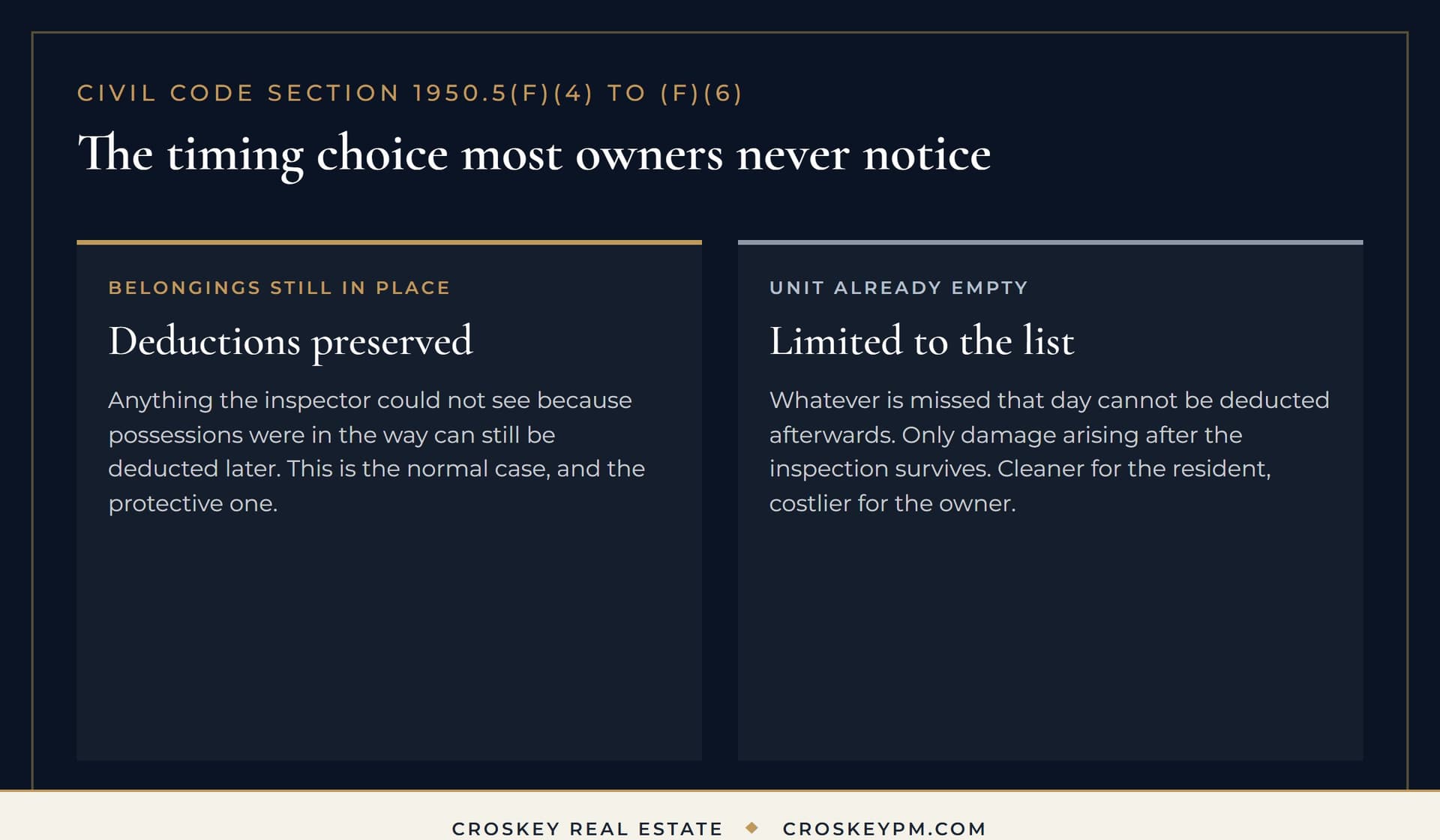
Under section 1950.5(f)(4), if an initial inspection is conducted and the unit contains no resident possessions blocking the view at the time, the housing provider may not later deduct for repairs or cleanings that were not named in that itemized statement. Whatever the inspector missed in an empty unit, the owner absorbs.
Two provisions soften that. Section 1950.5(f)(5) preserves deductions for itemized items the resident did not cure. Section 1950.5(f)(6) preserves deductions for damage that occurred after the inspection, and for damage that could not be identified because the resident's possessions were in the way.
The practical consequence is a timing decision that most owners never realize they are making:
- Inspect while the resident's belongings are still in place, which is the normal case, and the owner keeps the ability to deduct for what was genuinely hidden.
- Inspect after the unit is already empty, and the owner is limited to the itemized list plus anything that happens afterward.
Neither is wrong. An empty-unit inspection produces a cleaner, fairer list for the resident. It simply carries a cost the owner should choose deliberately rather than discover later.
This is also worth explaining to the resident at the time, because it prevents the argument later. The initial inspection is not the final one, and it usually happens while furniture, boxes, rugs and wall hangings are still in the home. A final accounting may still include deductions for problems that arose after that inspection, and for problems that could not be identified during it because possessions were in the way. A resident who hears this up front is far less likely to read the final statement as a bait and switch.
Those are the only two carve-outs. There is no general exception for anything an inspector simply did not notice in an empty unit, which is what makes the timing decision matter.
Why it pays to get the resident to accept it
Residents often decline because they are confident the home is immaculate. That confidence is usually sincere, and it is worth a second conversation, because an accepted inspection serves the owner at least as much as the resident.
The initial inspection is a preview of what a professional inspector will write down. Even a meticulous resident tends to miss the same things: dust on ceiling fan blades, grit in sliding door tracks, grease inside a range hood, a cracked refrigerator bin, a missing garage remote, nail holes past ordinary wear, bent blinds, burned out bulbs, pet odor that the household stopped noticing months ago, items left in a storage cupboard, and scuffs that look different in daylight than under a lamp.
Accepting the inspection converts all of that from a surprise on the final statement into a list with time left to act on it. Section 1950.5(f)(3) gives the resident the period between the inspection and the end of the tenancy to remedy what was identified.
The owner gains twice. An inspection two weeks out is two weeks of turnover planning, with vendors lined up, materials ordered and scope written before the keys come back. And every item the resident fixes themselves is an item nobody has to pay a vendor to fix. Vacancy is almost always more expensive than the disagreement.
Returning possession
Move-out is not complete because the home looks empty. It usually means removing all personal property, returning every key, remote and access device, cleaning, removing trash, handling yard obligations, confirming a forwarding address, closing or transferring utilities, and leaving the home secure.
Keys matter more than residents expect. A retained key can delay the final inspection and, in some circumstances, raise a question about whether possession was actually returned.
Croskey residents preparing to move should work from the resident move-in and move-out checklist, which includes a printable room-by-room PDF; a similar list is used when any deposit deductions are calculated.
The final move-out inspection and the photograph rules
The final inspection happens after the resident has vacated and returned possession. It compares the final condition against the move-in baseline, the maintenance history and the initial inspection findings.
Photographs are mandatory here. Under section 1950.5(g)(2), beginning April 1, 2025, the housing provider must take photographs of the unit within a reasonable time after possession is returned and before any repairs or cleanings that will be the basis of a deduction, along with photographs after that work is done.
Those photographs have to reach the resident. If a deduction is made for repairs or cleanings, the housing provider must provide the photographs together with a written explanation of the cost. Delivery can be by mail, email, flash drive, or a link where the resident can view them online.
An owner who deducts without photographs is now exposed on the documentation itself, independent of whether the underlying charge was fair.
Ordinary wear and tear
California allows deductions for damage but not for ordinary wear and tear, and the phrase is not defined by statute. The working test used in practice is straightforward:
Would this have happened anyway, with a reasonable person living in the home normally, for this length of time?
Traffic patterns worn into carpet after four years is wear. A burn hole is damage. Paint dulled and lightly scuffed is wear. A wall crayoned by a toddler is damage. Hinges loosening is wear. A door kicked off its frame is damage.
Length of tenancy is the variable owners most often ignore. The same faded paint is ordinary after five years and questionable after five months. Because there is no statutory line, this is where documentation does the arguing, which is the entire purpose of the process above.
When fair housing changes the process
The inspection process is a policy, and policies can require adjustment for residents with disabilities under the federal Fair Housing Act and California's Fair Employment and Housing Act.
In practice this can mean more notice than 48 hours, restricting the inspection to certain times of day, allowing a support person or caregiver to attend, or giving enough warning to secure an assistance animal before anyone walks through. A resident does not have to use the words "reasonable accommodation" for the request to count, and it does not have to be in writing.
One distinction is worth stating plainly because it is regularly confused. Assistance animals are not pets, so pet deposits, pet rent and pet fees do not apply to them. Actual damage caused by an assistance animal is still chargeable as damage, on the same terms as any other damage. The animal's status changes what may be charged in advance, not who is responsible for a repair.
Finally, cleaning and condition standards have to be applied the same way to everyone. Charging one household for a level of cleaning that another was not charged for is differential treatment, no matter how carefully each individual inspection was documented.
Familial status deserves specific attention, because it is a protected class under both the federal Fair Housing Act and FEHA, and because move-out charges are where it tends to surface. Marks on walls at child height, wear in hallways, scuffed baseboards and a thin patch of lawn all appear more often in households with children. Charging those as damage, when the same conditions in a household without children would have been called ordinary wear, is the pattern a fair housing complaint is built from. The question is the condition itself, not who lived there.
For owners in Contra Costa County
Croskey Real Estate manages single-family rentals and small multifamily properties for owners of one to ten doors in Pittsburg, Antioch, Brentwood, Oakley, Bay Point and Concord. The inspection and deposit rules above are state law and apply identically across all of them, though local ordinances can add requirements on top.
For our managed properties, this whole sequence runs as a documented workflow: move-in, move-out and scheduled condition assessments follow a standard format so every report is comparable over time, the photographs and the work-order history live in one property record, and the statutory notices go out on the statutory clock. Under full-service management all of that is our job. Under lease-only placement we complete the move-in documentation at placement, and the process is yours from there.
The inspection rules are one strand of a larger rulebook: if you want the rent cap, the deposit ceiling and the new 2026 duties in one place, our California landlord laws guide puts them side by side.
Our read, from the operator’s chair
The deposit argument we almost never have is the one the file already settles. A move-out goes quiet when the folder holds the signed move-in form, photographs from both ends of the tenancy, and the maintenance log in between; it goes loud when any of those is missing, because then the question stops being what the carpet looked like and becomes whose memory wins. Running East Contra Costa turnovers, the habit that earns its keep is the boring one: the same room-by-room form on every unit, photographs filed the same day, and the initial-inspection notice sent the day notice to terminate arrives, not the week after. None of it is extra work at the end; it is ten minutes at each step, placed where the statute already requires you to be standing.
The bottom line
Do five things consistently and most deposit disputes never start. Document the move-in condition, including photographs for tenancies beginning on or after July 1, 2025. Keep the maintenance record clean through the tenancy. Send the written initial inspection notice, with the required statutory paragraph, as soon as notice to terminate is given. Decide deliberately whether the initial inspection happens before or after the resident's belongings are out. Photograph the unit at move-out, before and after any work, and send those photographs with any deduction.
The process is not adversarial. It is what allows an owner to charge fairly and a resident to be charged fairly, and it works best when neither side is surprised.
Take the checklist with you: download the printable move-in / move-out checklist (PDF) and use it at your next turnover. If you would rather have the whole sequence handled for you, schedule a call or phone (925) 336-3282.
This guide is general information about California law and is not legal advice for any particular situation. Rules can vary with property type, lease terms, local ordinances and individual facts. Consult an attorney about your circumstances.
Frequently asked questions
Does a California housing provider have to offer a pre move-out inspection?
Yes, in most cases. Once either party gives notice to end the tenancy, Civil Code section 1950.5(f)(1) requires the housing provider to notify the resident in writing of the option to request an initial inspection and of the right to be present. The notice must include specific statutory language about reclaiming abandoned personal property.
What happens if the resident does not request the initial inspection?
The statute states that if a tenant chooses not to request an initial inspection, the duties under that subdivision are discharged. The obligation is to make the written offer, not to obtain the resident’s agreement. That discharge is narrow: it covers only the initial inspection duties in subdivision (f). The photograph requirements, the itemized statement, the deposit deadline and the limits on what may be deducted all continue to apply.
What happens if a housing provider wrongfully keeps a security deposit in California?
Section 1950.5(m) allows statutory damages of up to twice the amount of the security, in addition to actual damages, for the bad faith claim or retention of a deposit. A court may award those damages whenever the facts warrant it, whether or not the resident specifically requested them.
How much notice is required for the initial inspection?
At least 48 hours prior written notice of the date and time, whether or not a mutually acceptable time was agreed. The notice can only be skipped if both parties sign a written waiver. The inspection may occur no earlier than two weeks before the termination or lease end date.
Can a housing provider still deduct for damage found after the initial inspection?
Yes, in two situations. Section 1950.5(f)(5) allows deductions for itemized items the resident did not cure. Section 1950.5(f)(6) allows deductions for damage occurring after the inspection and for damage that could not be identified because the resident’s possessions were in the way. If the unit was already empty at the initial inspection, the housing provider is otherwise limited to the itemized statement.
Does California require photos at move-in and move-out?
For tenancies beginning on or after July 1, 2025, the housing provider must photograph the unit immediately before or at the start of the tenancy. Beginning April 1, 2025, the housing provider must photograph the unit after possession is returned and before any repairs or cleanings that will support a deduction, and again after that work. Photographs must be provided to the resident with any deduction.
What counts as ordinary wear and tear in California?
There is no statutory definition. The working test is whether the condition would have occurred anyway with a reasonable person living in the home normally for that length of time. Worn carpet traffic patterns and dulled paint are ordinary wear. Burns, crayon on walls and a kicked-in door are damage. Length of tenancy matters, which is why documentation decides most disagreements.
When does the initial inspection requirement not apply?
Section 1950.5(f)(7) provides that the requirements of that subdivision do not apply when the tenancy is terminated under Code of Civil Procedure section 1161, subdivisions (2), (3) or (4), which cover nonpayment of rent, breach of a lease covenant, and nuisance, waste or unlawful use.
Sources