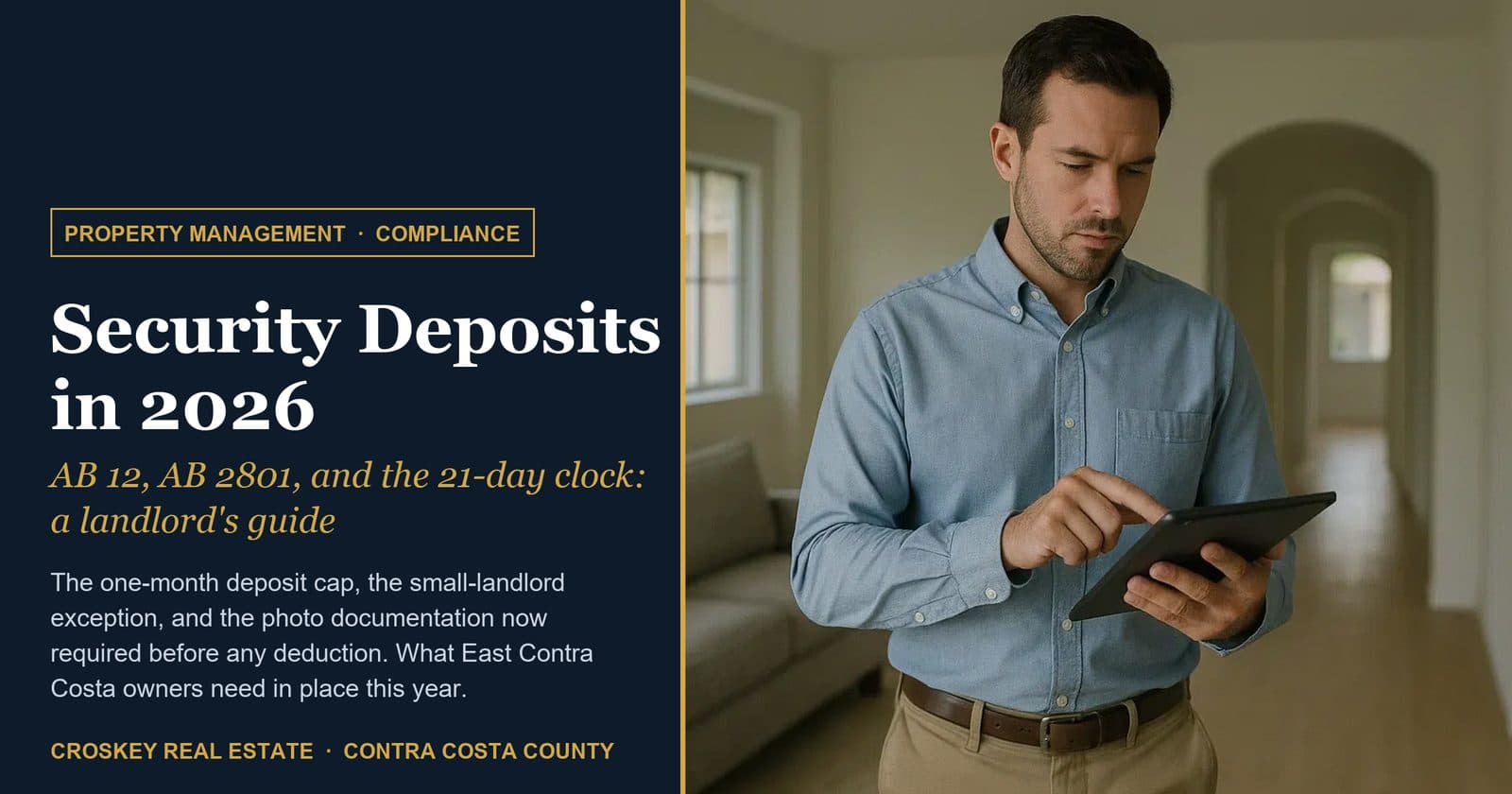
California's security deposit rules changed three times in three years, and 2026 is the first year all three are in force at once. AB 12 capped most deposits at one month's rent for tenancies that began on or after July 1, 2024. AB 2801 made photographs a condition of any deduction, at move-out since April 1, 2025 and at move-in for tenancies that began on or after July 1, 2025. And AB 414, effective January 1, 2026, changed how the money goes back: a resident who paid rent electronically is entitled to an electronic refund, and the refund to several adult residents goes out as one check payable to all of them unless everyone agreed otherwise in writing. All of it lives in Civil Code 1950.5, and the 21-day clock has not moved. For a housing provider (landlord) in Pittsburg, Antioch, Brentwood, Oakley, Bay Point or Concord, the pieces that matter are the cap, the exception, the photographs, the itemized statement, the new return rules, and the way the deposit is run from move-in to refund. The rest of the 2026 rulebook is in our California landlord laws guide.
How much can a landlord charge in 2026?
Under subdivision (c) of Civil Code 1950.5, a landlord may not demand or receive security of more than one month's rent, in addition to the first month's rent paid before move-in. The old two-months-unfurnished and three-months-furnished framework is gone for tenancies that began on or after July 1, 2024. Deposits collected under the old limits before that date did not have to be refunded down to the new cap; the cap applies when a new tenancy begins.
Three details are easy to miss. First, "security" is defined broadly in subdivision (b): any payment, fee, deposit or charge imposed at the beginning of the tenancy to reimburse the landlord for processing a new tenant, or as an advance payment of rent, counts toward the one month, whatever it is called. Application screening fees under Civil Code 1950.6 are the stated exception; our tenant screening guide covers those. Second, subdivision (n) prohibits any lease language calling security "nonrefundable." Third, the cap does not prohibit an advance payment of six months' rent or more when the lease term is six months or longer; that is prepaid rent, not security, and most owners never use it.
Who qualifies for the small-landlord exception?
Subdivision (c)(5) allows up to two months' rent when both of the following are true:
- The landlord is a natural person, or a limited liability company in which every member is a natural person. Since 2026 the statute spells out that "natural person" includes the settlor or beneficiary of a family trust, meaning a revocable or irrevocable trust whose settlors and beneficiaries are close relatives within the degrees the statute lists. Our living trust versus LLC guide explains why that distinction matters beyond deposits.
- The landlord owns no more than two residential rental properties that together include no more than four dwelling units offered for rent.
Even when an owner qualifies, the exception never applies to a prospective resident who is a service member, and the statute adds that an owner may not refuse to rent to a service member because the higher deposit is unavailable. A separate rule in subdivision (c)(4), in force since April 1, 2025, says that if a service member is charged more than the standard or advertised security for any reason tied to their application, the owner must give a written statement of the amount and the reason on or before lease signing, and must return the extra amount after six months of residency if rent is current, with that date written into the lease.
In practice, many East Contra Costa owners with a single rental do qualify, but ownership through most companies, or a third property, ends the exception. When in doubt, charge one month.
What can be deducted, and what cannot
Subdivision (b) lists the only purposes a deposit may serve: unpaid rent, repair of damage beyond ordinary wear and tear caused by the resident or a guest, cleaning needed to return the home to the level of cleanliness it had at move-in, and, if the lease allows it, restoring or replacing personal property such as keys or remotes. Subdivision (e) draws the lines around those purposes. Deductions must be reasonably necessary. Nothing may be charged for conditions that existed before the tenancy, for ordinary wear and tear, or for the cumulative wear of several tenancies. Labor and materials are limited to a reasonable amount needed to restore the home to its move-in condition. And professional carpet cleaning or other professional cleaning cannot be charged unless it is reasonably necessary to return the home to its move-in condition; a flat carpet fee regardless of condition does not meet that standard.
The pre-move-out inspection
Subdivision (f) gives the resident a right most owners underuse. Within a reasonable time after either side gives notice, the owner must tell the resident in writing that they may request an initial inspection and may be present for it. If requested, the inspection happens no earlier than two weeks before the move-out date, on 48 hours' written notice unless both sides waive it in writing, and the owner then gives the resident an itemized statement of the repairs or cleaning that would otherwise be deducted, including the text of the four allowed purposes. The resident has until move-out to fix what is listed. If the home was empty enough to inspect and the owner later tries to deduct for something that was visible but not listed, that deduction is not allowed. The inspection protects both sides: the resident gets a chance to avoid deductions, and the owner gets a documented list before the keys come back.
What AB 2801 requires before deducting
Subdivision (g) sets the photograph rules:
- Move-out photos: since April 1, 2025, photographs within a reasonable time after possession is returned and before any repair or cleaning that will be deducted, and again after the work is completed.
- Move-in photos: for tenancies that began on or after July 1, 2025, photographs immediately before or at the start of the tenancy, as the baseline for comparison.
- Share them: under subdivision (h)(2)(D), the photographs go to the resident with the itemized statement and a written explanation of each cost, by mail, email, flash drive or an online link.
For owners, this makes disciplined move-in documentation the single most valuable habit in the deposit process. A deduction without a photo trail is difficult to defend, and under subdivision (m) the owner carries the burden of proving every amount claimed.
The 21 days, the statement, and the new return rules
Under subdivision (h), no later than 21 calendar days after the resident has vacated, the owner must furnish an itemized statement showing the security received, each deduction and its basis, and return the balance. The statement may go out as early as the notice to terminate, or 60 days before a fixed-term lease ends.
What travels with the statement. If the owner or an employee did the work, a description of the work, the time spent and the hourly rate. If a vendor did it, a copy of the bill or invoice, with the vendor's name, address and telephone number if the invoice lacks them. For materials, the receipt or a vendor price list. For any deducted repair or cleaning, the photographs. If a repair cannot be finished, or a vendor's invoice is not in hand, within the 21 days, the owner may deduct a good-faith estimate and then send the final documents within 14 calendar days of completing the work or receiving the invoice. The documentation requirement does not apply when total deductions for repairs and cleaning are $125 or less, unless the resident asks for the documents within 14 days of receiving the statement, in which case the owner has 14 days to provide them.
How the money goes back, from January 1, 2026. AB 414 rewrote the delivery rules. The default is personal delivery or a check payable to the resident sent by first-class mail. But if the owner received the security or rent payments electronically, the balance must be returned electronically to a bank account the resident designates in writing, or by another electronic method the owner offers and the resident accepts in writing, unless the two sides agree in writing on a different method. The owner must notify the resident in writing of the right to an electronic refund within a reasonable time after either side gives notice. The itemized statement may be emailed if the resident agreed to that at any point.
Several adult residents. Unless the owner and every adult resident sign an agreement setting out how the balance is split and where each person's statement goes, the refund is one check payable to all the adult residents named on the lease, and the statement goes to any one of them. A roommate who leaves early under Civil Code 1946.7 may ask for a different arrangement.
The penalty. Under subdivision (m), a bad-faith claim or retention of any part of the deposit exposes the owner to statutory damages of up to twice the deposit, on top of actual damages, and the court may award them whether or not the resident asked. A natural person can bring the claim in small claims court for up to $12,500 under Code of Civil Procedure 116.221. Subdivision (h)(7) adds that an owner who fails in bad faith to comply with the statement rules forfeits any claim on the deposit at all.
When the property changes hands
Subdivisions (i) through (k) govern a sale, transfer or change of manager during a tenancy. The outgoing owner must either transfer the remaining deposit to the successor and notify the resident of the transfer, the amount and the successor's name, address and telephone number, or return it to the resident with an accounting. Before a voluntary sale, the seller must give the buyer a written statement of the deposit remaining, any lawful deductions and which option was chosen. If that does not happen, the buyer becomes jointly liable with the seller for the deposit and may not demand a replacement deposit from the resident until it is sorted out. Our guide to selling a rental with tenants in place covers the rest of that transaction.
How Croskey runs the deposit
Under our management agreement, the resident's security deposit is held either by the owner or in Croskey's trust account, as the agreement specifies, and when it is held by us we pay any interest owed to residents under local law. One month's rent is the standard deposit we collect, which is what the qualification requirements page tells every applicant, and the deposit cannot be used as the final month's rent, which the move-in and move-out checklist tells every resident.
The documentation runs on the law's calendar. Before keys are handed over, the home's condition is recorded with date-stamped photographs and video, so the move-in baseline AB 2801 requires exists before the tenancy does. When a resident gives notice through the notice to vacate process, the pre-move-out inspection is offered, and the same room-by-room cleaning checklist we publish is the one used when deductions are calculated, so the resident is measured against a list they already have.
After move-out, the inspection photographs are taken before any work and again after it. Every itemized statement is written by a person and approved by a person before it goes out; software tracks the 21-day clock and drafts the paperwork, but it does not decide a deduction. The statement itself follows a fixed structure: the deposit amount and the date it was received, the move-out date, each deduction with the invoice reference behind it, the total, the refund due, and the photographs. Our operating standard is every refund inside the 21-day window, and the trust account that holds deposits is reconciled monthly so the deposit ledger and the bank agree.
Quick reference for 2026
| Rule | What it says | Where |
|---|---|---|
| Maximum deposit | One month's rent for tenancies from July 1, 2024; any start-of-tenancy fee counts toward it | 1950.5(b), (c)(1) |
| Small-landlord exception | Two months; natural persons, all-natural-person LLCs and family trusts only; two properties, four units; never for service members | 1950.5(c)(5) |
| Photos | Move-out before and after work since April 1, 2025; move-in for tenancies from July 1, 2025; shared with the statement | 1950.5(g), (h)(2)(D) |
| Deadline | 21 calendar days after the resident vacates | 1950.5(h)(1) |
| Receipts | Required when deductions exceed $125; estimate allowed, final documents within 14 days | 1950.5(h)(2), (3), (4) |
| Electronic refund | Required when rent or security was paid electronically, unless agreed otherwise in writing; written notice of the right | 1950.5(h)(1)(A)(ii), from January 1, 2026 |
| Several residents | One check payable to all unless a signed agreement sets the split | 1950.5(h)(1)(C) |
| Penalty | Up to twice the deposit in statutory damages for bad faith; owner bears the burden of proof; small claims up to $12,500 | 1950.5(m), (o); CCP 116.221 |
| Sale or transfer | Transfer the deposit and notify the resident, or return it; written statement to the buyer | 1950.5(i), (j), (k) |
Our read, from the operator's chair
The deposit dispute we almost never have is the one where the move-in photographs exist. What follows are patterns from our move-out files, not one resident's story. When a resident questions a deduction, the conversation ends when both sides are looking at the same two photographs of the same wall, one from move-in and one from move-out. The disputes that drag on are the ones inherited with a takeover, where the previous arrangement had no move-in record and the deduction becomes an argument about memory.
The second pattern is the pre-move-out inspection. Residents who take it almost always fix most of the list, and the final statement is short. Residents who skip it are measured against the same checklist, but without the chance to act on it, and the statement is longer. Offering the inspection in writing, every time, is the cheapest dispute prevention in the process.
The third pattern is timing. Vendor invoices do not respect the 21 days. The statute's estimate rule exists for that reason, and a statement that says "estimated, final invoice to follow within 14 days" and then follows through is compliant; a statement that waits for the invoice and goes out on day 25 is not. The clock, not the invoice, decides when the statement goes out.
Where to go from here
The deposit and the inspection are one process: what can be deducted depends on the documentation sequence that came before it. The move-in and move-out inspections guide walks that sequence start to finish, with the notice language and the photo checklist. If you would rather hand the whole sequence to a manager, a consultation is the simple way to ask how we would run it for your home.
This guide is general information for California rental owners, not legal advice. Civil Code 1950.5 is cited as amended by AB 414, effective January 1, 2026, and changes; for a specific situation, consult a California landlord-tenant attorney. Croskey Real Estate is an Equal Housing Opportunity provider. DRE #01990430.
Frequently asked questions
How much security deposit can a landlord charge in California in 2026?
One month's rent for most residential tenancies that began on or after July 1, 2024, in addition to the first month's rent (Civil Code 1950.5(c)). Any fee charged at the start of the tenancy to cover processing costs counts toward that one month, and no part of it may be called nonrefundable. A landlord who is a natural person, an LLC whose members are all natural persons, or a family trust, and who owns no more than two residential rental properties with four units in total, may charge up to two months, except from a service member.
Do landlords have to photograph the unit before deducting from a deposit?
Yes. Since April 1, 2025, the landlord must photograph the unit after the resident returns possession and before any repair or cleaning that will be deducted, and again after the work is done. For tenancies that began on or after July 1, 2025, photographs at move-in are required as the baseline. The photographs go to the resident with the itemized statement, by mail, email, flash drive or an online link (Civil Code 1950.5(g) and (h)(2)(D)).
How long does a California landlord have to return a security deposit?
21 calendar days after the resident vacates. Within that time the landlord must send an itemized statement of any deductions, with receipts or invoices when repair and cleaning deductions exceed $125 and the required photographs, and return the balance. If a repair is unfinished or an invoice has not arrived, the landlord may deduct a good-faith estimate and send the final documents within 14 days. Bad-faith retention can cost up to twice the deposit in statutory damages.
What changed on January 1, 2026 under AB 414?
How the refund is delivered. If the landlord received the security or rent electronically, the remaining deposit must be returned electronically to a bank account the resident designates in writing, or by another electronic method both sides accept in writing, unless they agree in writing on a different method; the landlord must notify the resident of that right when either side gives notice. When several adult residents share a unit, the refund is one check payable to all of them, and the statement goes to any one of them, unless everyone signs an agreement setting a different split and delivery.
Did AB 12 require refunding deposits collected before July 2024?
No. The one-month cap in Civil Code 1950.5(c) does not apply to security collected or demanded before July 1, 2024, so a two-month deposit collected under the earlier rules did not have to be reduced. The cap applies when a new tenancy begins.
What happens to the security deposit when a rental is sold or changes managers?
Under Civil Code 1950.5(i) through (k), the outgoing owner must either transfer the remaining deposit to the new owner and notify the resident in writing of the transfer, the amount and the new owner's contact details, or return the deposit to the resident with an accounting. Before a voluntary sale the seller must give the buyer a written statement of the deposit remaining and any deductions. If that does not happen, the buyer is jointly liable for the deposit and may not demand a replacement deposit from the resident.
Sources
- California Civil Code section 1950.5 (security deposits), as amended by AB 414 effective January 1, 2026, retrieved October 2026
- AB 414 (2025), Residential tenancies: return of security, Chapter 340, approved October 6, 2025, retrieved October 2026
- AB 12 (2023), Tenancy: security deposits (one-month cap), retrieved October 2026
- AB 2801 (2024), Tenancy: security deposits (photo documentation), retrieved October 2026
- California Code of Civil Procedure section 116.221 (small claims jurisdiction, $12,500), retrieved October 2026
- Croskey Real Estate, qualification requirements (deposit standard), retrieved October 2026
- Croskey Real Estate, move-in and move-out checklist (pre-move-out inspection right, cleaning checklist), retrieved October 2026
- Croskey Real Estate, notice to vacate process, retrieved October 2026