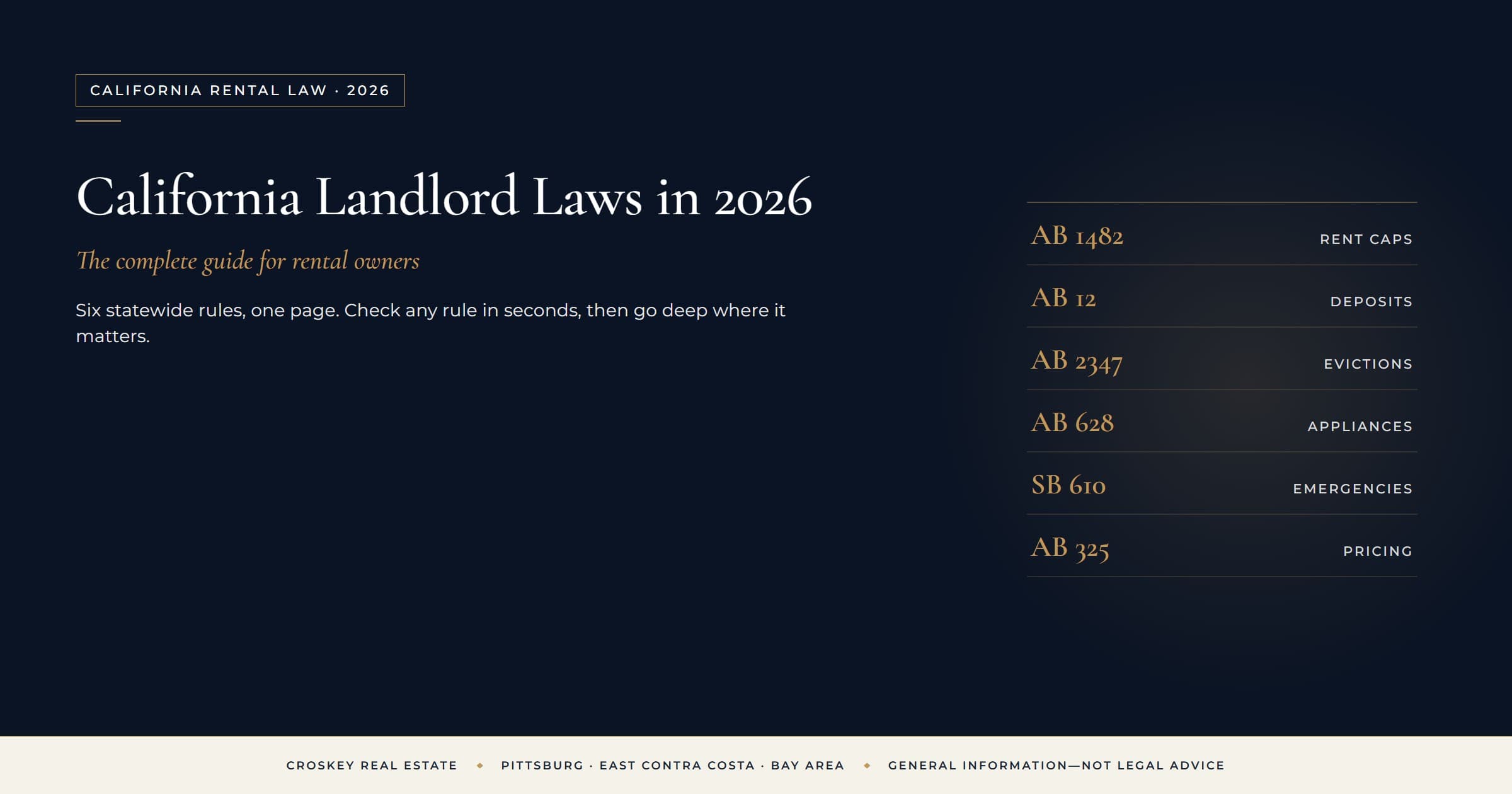
California passed more landlord-facing law in the last three years than in the previous ten, and 2026 is the first year all of it applies at once. Rent caps, a new deposit ceiling, longer eviction timelines, appliance requirements, emergency duties, even rules about your pricing software. Each rule has its own detailed guide on this site; this page is the map. Use it to check any rule in seconds, then follow the link when you need the full picture.
The 2026 rules at a glance
| Law | What it does | Applies since | Full guide |
|---|---|---|---|
| AB 1482 + SB 567 | Caps rent increases at 5% + CPI (max 10%) and requires just cause to end most tenancies | 2020, tightened April 2024 | AB 1482 guide |
| AB 12 | Caps security deposits at one month's rent for most owners | July 1, 2024 | Deposit guide |
| AB 2347 + CCP 1167 | Extends a tenant's eviction response window to 10 court days | January 2025 | Response-window guide |
| AB 628 | Makes a working stove and refrigerator part of habitability | New and renewed leases, 2026 | AB 628 guide |
| SB 610 | Sets landlord duties during declared emergencies and wildfires | 2026 | SB 610 guide |
| AB 325 | Bans algorithmic rent coordination among competing landlords | 2026 | AB 325 guide |
| AB 414 | Requires electronic refund of a security deposit that was paid electronically | 2026 | This guide |
| AB 1414 | Lets tenants opt out of paying for bundled third-party internet subscriptions | 2026 | This guide |
Our read, from the operator’s chair
A single 2026 move-out touches four rules at once: the deposit ceiling caps what can be held, the inspection notice runs on its own clock, the photographs are mandatory before and after any work that gets deducted, and the refund deadline arrives whether the paperwork is ready or not. Get one wrong and the others stop protecting you; a clean deduction delivered late is still a violation.
That interaction is the real change. After two decades running East Contra Costa rentals, it is where owners get hurt: rarely by a rule they did not know, usually by two rules colliding in the same week. The system that survives it is unglamorous: every notice, dollar and photograph landing in the same property file, so no rule gets handled from memory.
Who carries which rule: the honest split
This hub is written for long-term owners of one to ten doors, single-family or small multifamily, in Pittsburg, Antioch, Brentwood, Oakley, Bay Point and Concord. Statewide portfolios and short-term rentals carry additional layers this page does not cover.
- Full-service management. For the rentals we manage, the rules on this page are absorbed into operations: the rent-cap math is verified at each renewal, the deposit ceiling and refund mechanics are handled at move-out, and notices with their statutory clocks are tracked in one property record. Court proceedings are attorney work on every path. Full-service management is that lane.
- Lease-only placement. With lease-only placement, we place a qualified resident and complete the move-in documentation; from that point, every rule on this page is yours to run.
- Self-managing. Entirely workable with a system: bookmark the guides linked in the table, calendar the statutory clocks, and pair the file with a landlord-tenant attorney for the sharp edges.
How much can you raise the rent in 2026?
For most California rentals older than 15 years, AB 1482, the Tenant Protection Act, caps annual increases at 5% plus your region's CPI, never more than 10% in any 12-month period. The same law requires just cause to end a covered tenancy, and SB 567 tightened the two most-used no-fault reasons in April 2024: owner move-in and substantial remodel now carry specific proof and follow-through requirements. The law is currently set to sunset on January 1, 2030, unless extended.
The practical trap is not the cap itself but the paperwork around it: increases served without the right notice period, or no-fault terminations that do not meet SB 567's tightened standards, can unwind an otherwise legitimate action. The full guide covers notices, exemptions, and the 2026 CPI math.
Security deposits: one month is the ceiling
Since July 1, 2024, AB 12 caps the security deposit for most residential rentals at one month's rent, furnished or not. The old two-and-three-month framework is gone for new tenancies. A narrow small-landlord exception allows up to two months, but it is stricter than most owners assume, and deposits collected before the cutoff under the old limits did not have to be refunded down.
Two operational notes matter in 2026. First, any pet deposit you charge counts inside the same one-month cap, not on top of it. Second, with less deposit cushion, move-in documentation and protecting the home from tenant damage carry more weight than they used to.
Ending a tenancy: just cause, notices, and the court process
Evictions in California are a sequence of deadlines, and missing one usually means starting over. Our step-by-step eviction guide for Contra Costa County walks the whole path and covers the fundamentals owners most often get wrong.
The timeline change many owners still miss: since January 2025, AB 2347 gives tenants 10 court days instead of 5 to respond to an unlawful detainer. Budget for a longer process and build your documentation before you serve anything, not after.
New for 2026: appliances and emergency duties
Two newer laws add obligations this year:
- AB 628 amends California's habitability statute so that a working stove and refrigerator are part of a habitable rental for new and renewed leases. If your units have historically rented without appliances, your next renewal is the moment this becomes real.
- SB 610 defines what landlords must do during and after a declared emergency, including wildfire events: contractor licensing for post-disaster repairs, rent obligations when a unit becomes uninhabitable, and remediation timelines. East Contra Costa's fire seasons make this one worth reading before you need it.
Your pricing software is now a legal question
AB 325 makes algorithmic rent coordination among competing landlords an explicit antitrust violation. If any tool you use recommends rents based on other landlords' non-public data, that is now a compliance question, not just a product choice. Comps built from public listings and your own portfolio remain fine; the full guide draws the line precisely.
Deposits and internet fees: two more 2026 rules
Two additional laws took effect January 1, 2026 that change routine parts of running a rental: how you refund a deposit, and whether you can charge for bundled internet.
AB 414 requires that a security deposit paid electronically be refunded electronically if the tenant asks. A deposit paid by check or money order is not covered by this requirement. Confirm the original payment method on your move-out checklist before issuing any refund, and keep a record of how the deposit was received.
AB 1414 applies to any residential tenancy that starts, renews, or continues month to month on or after January 1, 2026. If the property includes a bundled third-party internet, cellular, or satellite subscription, the tenant can opt out of paying for it. Bulk-billed internet as a building amenity is still allowed, but a tenant who declines cannot be charged, and retaliating against a tenant for opting out is prohibited. A landlord who bills anyway risks the tenant deducting the subscription cost directly from rent.
Day-to-day rules owners ask about
Beyond the headline laws, two operational areas generate constant questions. Marijuana is legal in California but landlords retain meaningful control through the lease; our marijuana and tenant rights guide covers smoking rules, cultivation limits, and enforcement. And tenant expectations themselves have shifted: the modern California renting experience is now shaped by these protections, which is worth understanding from the resident's side of the table.
Who enforces all of this?
No single agency. The Department of Real Estate licenses brokers and property managers, the Civil Rights Department handles fair housing, courts handle unlawful detainer, and cities add their own layer: inspection programs and local ordinances that go beyond state law in several East County cities. Our guide to who regulates property managers in California maps the full landscape, and regulatory change is now constant enough that treating compliance as an annual checkup, not a one-time setup, is the only durable approach.
Frequently asked questions
What is the maximum rent increase in California in 2026?
For rentals covered by AB 1482, 5% plus your regional CPI, with a hard ceiling of 10% in any 12-month period. Newer construction and some single-family homes are exempt; the exemptions have their own notice requirements.
How much security deposit can a California landlord collect in 2026?
One month's rent for most owners, whether the home is furnished or unfurnished, under AB 12. A narrow small-landlord exception allows up to two months. Any pet deposit counts inside the cap, not on top of it.
How long does a tenant have to respond to an eviction in California?
10 court days, up from 5, under AB 2347 and CCP Section 1167 since January 2025. Weekends and court holidays do not count, so the real-world window is over two weeks.
Do California landlords have to provide a stove and refrigerator?
Under AB 628, a working stove and refrigerator are part of habitability for new and renewed leases. Owners who historically rented without appliances should plan for this at their next renewal.
Do California landlords have to refund a security deposit electronically?
Only if the tenant paid the deposit electronically and asks for an electronic refund. Under AB 414, the landlord must then return it through the same method the tenant used to pay. Deposits paid by check or money order are not covered.
Can a California landlord charge tenants for bundled internet service?
Not if the tenant opts out. Under AB 1414, tenants can decline to pay for a bundled third-party internet, cellular, or satellite subscription included with the tenancy, for any tenancy starting, renewing, or continuing month to month on or after January 1, 2026. Bulk billing is still allowed for tenants who accept it, and landlords cannot retaliate against a tenant who opts out.
Who regulates property managers in California?
Several bodies at once: the Department of Real Estate licenses brokers and property managers, the Civil Rights Department enforces fair housing, courts handle evictions, and many cities run their own rental inspection and ordinance programs.
Sources
- California Civil Code Section 1947.12 (AB 1482 rent cap)
- California Civil Code Section 1950.5 (AB 12 security deposits)
- AB 2347 (2024): unlawful detainer response timelines
- California Civil Code Section 1941.1 (habitability standards)
- California Department of Real Estate
- AB 414 (2025) - Residential tenancies: return of security
- AB 1414 (2025) - Landlord-tenant: internet service provider subscriptions