No single agency regulates property managers in California. Who you call depends on what went wrong.
The five doors, in one table
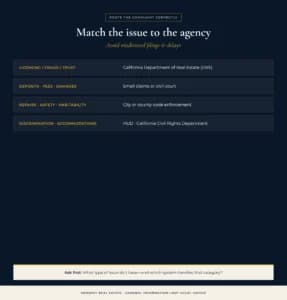
Licensing, broker conduct and trust-account problems go to the California Department of Real Estate (DRE). Deposit, fee and damage disputes go to small claims or civil court. Repairs and unsafe conditions go to city or county code enforcement. Discrimination and accommodation issues go to the California Civil Rights Department or HUD. Rent-cap and just-cause questions go to your city's rent program where one exists, and in East Contra Costa that means Antioch and Concord. This guide maps each door for a housing provider (landlord) or a resident in Pittsburg, Antioch, Brentwood, Oakley, Bay Point or Concord, explains what the DRE will and will not do, and shows how to verify a manager before you sign anything. The rulebook behind all of it is summarized in our California landlord laws guide.
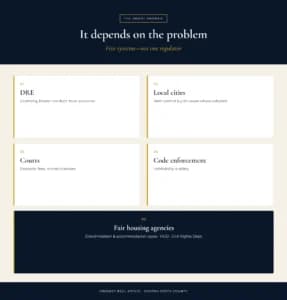
The useful question is what kind of problem you have. Each row is a different system, with its own powers and limits.
| If the problem is | Where it goes | What that system can do |
|---|---|---|
| An unlicensed manager, a broker who misrepresented something, missing or mishandled client money, undisclosed fees | California Department of Real Estate | Investigate, discipline or revoke a license, refer for prosecution. It cannot order a refund. |
| A deposit not returned or itemized, a fee you dispute, damage to the home | Small claims or civil court | Order money paid, including the statutory penalties in Civil Code 1950.5 |
| No heat, mold, a broken lock, an unsafe unit | City or county code enforcement, depending on where the home sits | Inspect, cite the owner, order repairs |
| Discrimination, a denied accommodation, harassment tied to a protected characteristic | California Civil Rights Department or HUD | Investigate, mediate, bring an enforcement action |
| A rent increase above a local cap, a no-fault eviction in a covered city | The city rent program: Antioch or Concord | Hear petitions, enforce the local ordinance |
Two things are true at once. A single bad month can touch three doors (a deposit dispute, a licensing question and a repair), and no door hands you to the next one. You route each piece yourself.
The DRE: what it does, and what it cannot do
The Department of Real Estate is the California state agency that issues real estate broker and salesperson licenses. It investigates complaints through its Enforcement Section, and it can suspend or revoke a license after a formal hearing.
What it handles. License violations and unlicensed activity, misrepresentation and false promises, mishandled trust funds, and broker conduct. The grounds for discipline in Business and Professions Code 10176 include commingling client money with the licensee's own money (subdivision (e)) and claiming any secret or undisclosed compensation or profit (subdivision (g)). An undisclosed markup on a repair invoice is the property management version of that second one; our guide to maintenance charges walks through what has to be in the agreement.
What it cannot do. The DRE's own complaint page says it plainly: it cannot act as a court, so it cannot order money refunded, contracts canceled or damages paid, and it cannot give legal advice. A deposit dispute filed with the DRE goes nowhere unless it also involves trust-fund misconduct.
Two tools people miss. The DRE's Complaint Resolution Program is an informal way to try to resolve simple complaints involving licensees. And the Consumer Recovery Account, funded by licensee fees since 1964, pays victims of intentional fraud or conversion of trust funds by a licensee who has no assets to collect from. You need a final court judgment, arbitration award or criminal restitution order first, you must apply within one year of it becoming final, and the limits are $50,000 per transaction and $250,000 per licensee under section 10474.
Does a property manager need a license in California?
Yes, in almost every paid arrangement. Business and Professions Code 10131(b) defines a real estate broker as anyone who, for compensation and for another person, leases or rents property, places it for rent, solicits listings or prospective tenants, negotiates leases, or collects rents. That is the job description of a property manager. There is no separate property manager license; the work is done under a broker license, directly or by a licensed salesperson supervised by the broker of record.
The exemptions that matter. Owners who manage their own rentals are not brokers; the license law reaches people who act for others. Under section 10131.01, the resident manager of an apartment building or complex, and that manager's employees, are exempt, and unlicensed employees of a management firm may show units, hand out and accept applications, accept deposits and rent, quote rents from a schedule and accept signed leases at an apartment complex, as long as they work under the supervision of the firm's broker of record. The exemption is written for apartment buildings. It does not turn an unlicensed person who leases and collects rent on scattered single-family homes for a fee into a lawful manager.
If the manager is not licensed. Acting as a broker without a license is a public offense under section 10139: a fine of up to $20,000 for a person or $60,000 for a corporation, up to six months in county jail, or both. The DRE has jurisdiction over unlicensed persons performing licensed acts, so the complaint door is the same. Practically, an unlicensed manager sits outside the license-based protections described below: the DRE trust-account rules and the three-year record requirement.
Trust accounts: the rule the DRE audits
For an owner, this is the part of the Real Estate Law that touches your money every month. Section 10145 requires a broker who accepts funds belonging to others to deposit them into a trust fund account at a bank or recognized depository in California, and to hold them there until disbursed on the instructions of the person entitled to them. Rent, owner reserves and any security deposits the broker holds are all "funds belonging to others."
The regulations under it set the bookkeeping. A broker must keep a chronological record of every trust dollar received and disbursed with a daily balance (10 CCR 2831), a separate record for each owner or transaction, and must reconcile the two at least once a month, keeping a dated record of each reconciliation (10 CCR 2831.2). Under section 10148, trust records and transaction documents are kept for three years and must be open to the Commissioner's examination, and a broker found to have violated the trust-fund rules pays for the audit. Withdrawals need the broker's signature or the written authorization of specific people, and an unlicensed employee with access to trust funds must be covered by a fidelity bond at least equal to the funds they can reach.
How Croskey runs it. Owner receipts, less amounts properly disbursed, are held in a California trust account at a financial institution insured by an agency of the United States government, separate from Croskey's own accounts. Tenant security deposits are either held by the owner or in that trust account, as the management agreement specifies, and interest owed to residents under local law is paid when deposits are held by us. The account is reconciled monthly, and records are retained per the DRE rule. Disbursements follow a fixed order each month: management compensation, operating expenses, reserves and deposits we hold, then the balance to the owner with a statement, plus a year-end statement for tax time. And because section 10176(g) makes undisclosed compensation a disciplinary offense, every fee we charge, from the monthly percentage to the $49 maintenance coordination fee on the Core plan, is on the pricing page before any agreement is signed.
Local rules in East Contra Costa
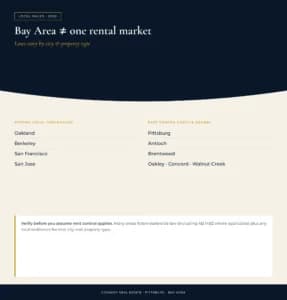
The Bay Area is a collection of overlapping jurisdictions. Larger Bay Area cities run rent boards, relocation payments and registration. East Contra Costa is lighter, but it is no longer uniform.
Antioch. The city adopted a Rent Stabilization Ordinance in October 2022 (Antioch Municipal Code Title 11, Chapter 3). For covered units the annual increase is capped at the lesser of 3 percent or 60 percent of the most recent 12-month change in the San Francisco-Oakland-Hayward consumer price index, and only one increase is allowed in any 12-month period. Homes with a certificate of occupancy issued after February 1, 1995, and single-family homes and condominiums that can be sold separately from other units, are exempt from the rent cap. Landlords subject to the ordinance must register those units with the city and pay the rent program fee. Antioch also has local rules on retaliation, harassment and tenant eviction protections (Title 11, Chapters 4 to 6). Details are at the Antioch Rent Program.
Concord. The Residential Tenant Protection Program (Concord Municipal Code Chapter 19.40) took effect April 19, 2024 and was amended in May 2025. The allowable annual rent increase is 5 percent as of August 1, 2025 for covered units, and rent stabilization does not apply to units with a certificate of occupancy issued after February 1, 1995. Single-family homes and condominiums are covered by just cause for eviction only when the same owner rents out three or more of them; an owner with two or fewer is exempt from both rent stabilization and just cause but still registers. Every owner who rents out one or more homes in Concord registers them annually in the city's rent registry and pays the registry fee. Details are at the Concord Rent Program.
Pittsburg, Brentwood, Oakley and Bay Point. As of October 2026 we know of no local rent cap or local just-cause ordinance in these places. The statewide Tenant Protection Act (AB 1482) applies where the property qualifies, and our AB 1482 guide covers which homes are covered and which are exempt. Check the city's housing page before assuming either way; local ordinances change on a council vote.
Code enforcement. Habitability complaints go to local code enforcement, the city or the county where the home sits. Code enforcement can inspect and cite, but it does not resolve rent or deposit disputes.
Courts and fair housing agencies
Money disputes. Deposits, disputed fees and damage claims are decided in court, not by an agency. Small claims handles most deposit cases; the California Courts self-help center explains the process and the current dollar limits. The security deposit statute, Civil Code 1950.5, sets the 21-day itemization deadline and the penalty for bad-faith retention, and our security deposit guide explains both from the owner's side.
Discrimination and accommodations. The California Civil Rights Department enforces the Fair Employment and Housing Act, which applies to landlords, tenant screening companies and property management companies alike, and HUD's Office of Fair Housing and Equal Opportunity enforces the federal Fair Housing Act. Either agency investigates; filing deadlines apply, so do not wait. Our tenant screening guide explains what a lawful, consistent screening process looks like from both chairs.
How to verify a property manager before you sign
Start with the DRE license lookup. Search the company name and the individual. You are looking for an active broker license for the company (a corporation is licensed through a designated officer) and the name of the responsible broker of record. If the person you are dealing with holds a salesperson license, confirm which broker they are licensed under; the broker is accountable for their work.
Then ask questions whose answers are documents, not assurances:
- Which bank holds the trust account, and how often is it reconciled? The answer should be a California bank and "monthly."
- Are security deposits held in the trust account or by me, and how is that written in the agreement?
- Where is the complete fee schedule, including any charge on maintenance, renewals, setup or cancellation? Under section 10176(g) it has to be disclosed before you sign. Ours is on the pricing page.
- What is the approval threshold for repairs, and what counts as an emergency?
- How and when do I receive statements and the year-end statement?
- Who handles the local rules in Antioch or Concord if my home is there?
A manager who cannot answer the first three in writing is telling you something.
How to file a complaint, step by step
- Name the problem type. Licensing or trust funds, money dispute, repairs, discrimination, or a local rent rule. One situation can produce more than one.
- Collect the record. The management agreement, the lease, notices, emails and texts, photos, invoices and bank records, in date order. The DRE's complaint page asks for legible copies of every document involved and says documentary evidence is "especially important."
- Route each piece. DRE for licensing and trust funds (Form RE 519 or the online complaint system); small claims or civil court for money; city or county code enforcement for habitability; the Civil Rights Department or HUD for discrimination; the Antioch or Concord rent program for a local cap or just-cause question.
- Escalate in order. A written notice to the manager, then a formal demand with a deadline, then the agency complaint or court filing. Keep proof of each step; it is what the next step runs on.
- If fraud or converted trust funds are involved, get the judgment first, then apply to the Consumer Recovery Account within one year of the judgment becoming final.
If you manage your own rental
Owners who manage their own property do not need a license, but every other door still applies to them. State landlord-tenant law, AB 1482 where it applies, the Antioch and Concord ordinances, fair housing law and habitability standards do not care whether a professional is involved. Self-management changes who does the work, not who is responsible. Our guide to self-managing or hiring a manager prices the two paths honestly, including the time the regulation map above represents.
Our read, from the operator's chair
A home arrives with a resident in place and a file from the previous arrangement, and the setup audits the lease and the ledger and verifies the security deposit before we take a dollar in. Two gaps are worth checking in any file from a previous arrangement. One is a deposit that was collected years ago and never recorded anywhere a successor can find. The other is a lease with no written fee schedule behind the charges on the statements. Both are exactly the records sections 10145 and 10148 exist to require, and both become a problem at move-out if they are not found at move-in.
A second problem is a routing mix-up. Deposit disputes land at the DRE, which cannot order a refund, and trust-account questions land in small claims, where the judge has no licensing power. The five-door table is there so each question reaches the right door first.
The regulatory map doubles as a hiring checklist. The questions the DRE would ask in an audit, which bank, how often reconciled, where is every fee disclosed, are the questions to ask a manager before you sign. A manager who answers them in writing before signing has already done the documentation an audit asks for.
Where to go from here
The DRE license lookup is the first step with any manager, including us; Croskey Real Estate is DRE #01990430, with Wolfgang Croskey as broker of record (DRE #01708438). For the rules each agency enforces, the California landlord laws guide keeps every current requirement in one place. And if you are weighing a manager for a home in Pittsburg, Antioch, Brentwood, Oakley, Bay Point or Concord, a consultation is a straightforward way to ask those trust-account and fee questions of us directly.
This guide is general information for California rental owners and residents, not legal advice. Statutes, regulations and local ordinances cited were checked against the official texts in October 2026 and change; the Antioch and Concord figures come from each city's municipal code and program page as of that date. Croskey Real Estate is an Equal Housing Opportunity provider. DRE #01990430.
Frequently asked questions
Who regulates property managers in California?
No single agency. The California Department of Real Estate regulates licensing, broker conduct and trust accounts; small claims and civil courts decide deposit, fee and damage disputes; city or county code enforcement handles habitability; the California Civil Rights Department and HUD handle discrimination; and cities with local ordinances, such as Antioch and Concord in East Contra Costa, run their own rent programs. Route the complaint by the type of problem.
Does a property manager need a license in California?
Yes, in almost every paid arrangement. Business and Professions Code 10131(b) treats leasing, soliciting tenants, negotiating leases and collecting rent for others as broker activity, so the work must be done under a real estate broker license, directly or by a supervised salesperson. There is no separate property manager license. Owners managing their own property and resident managers of an apartment complex are exempt. Unlicensed activity is a public offense under section 10139, with fines up to $20,000 for a person and $60,000 for a corporation.
What does the California Department of Real Estate do about a property manager?
It investigates written complaints against licensees and unlicensed persons, and it can suspend or revoke a license for misrepresentation, commingling client money or taking undisclosed compensation (section 10176). It cannot order money refunded, cancel a contract or award damages; those go to court. For intentional fraud or stolen trust funds, its Consumer Recovery Account pays final judgments up to $50,000 per transaction when the licensee cannot.
How do I verify a property manager's license in California?
Use the DRE public license lookup at www2.dre.ca.gov. Search the company and the individual, confirm an active broker license and the responsible broker of record, and if the person holds a salesperson license, confirm which broker they work under. Then ask which bank holds the trust account, how often it is reconciled, and where the complete fee schedule is published. Croskey Real Estate is DRE #01990430.
What are the trust account rules for California property managers?
Under Business and Professions Code 10145, money a broker holds for others must be deposited in a trust fund account at a California bank and held until disbursed on the owner's instructions. Regulations require a chronological record of every receipt and disbursement, a separate record per owner, and a reconciliation at least once a month (10 CCR 2831 and 2831.2). Records are kept for three years and are open to DRE audit (section 10148). Commingling client money with the broker's own money is grounds for revocation.
Which East Contra Costa cities have local rent control?
As of October 2026, Antioch and Concord. Antioch's Rent Stabilization Ordinance, adopted in October 2022, caps annual increases at the lesser of 3 percent or 60 percent of CPI for covered units, and the city has local rules on retaliation, harassment and eviction protections. Concord's Residential Tenant Protection Program, effective April 19, 2024, caps increases at 5 percent as of August 1, 2025 for covered units and requires every rented home to be registered annually. Pittsburg, Brentwood, Oakley and Bay Point follow state law, including AB 1482 where it applies.
Sources
- California Business and Professions Code section 10131 (definition of real estate broker), retrieved October 2026
- California Business and Professions Code section 10131.01 (resident manager and apartment-complex exemptions), retrieved October 2026
- California Business and Professions Code section 10139 (penalties for unlicensed activity), retrieved October 2026
- California Business and Professions Code section 10145 (trust fund accounts), retrieved October 2026
- California Business and Professions Code section 10148 (records retention and audits), retrieved October 2026
- California Business and Professions Code section 10176 (grounds for discipline), retrieved October 2026
- California Business and Professions Code section 10474 (Consumer Recovery Account limits), retrieved October 2026
- 10 California Code of Regulations sections 2831 and 2831.2 (trust fund records and monthly reconciliation), retrieved October 2026
- California Department of Real Estate, Filing a Complaint, retrieved October 2026
- California Department of Real Estate, Consumer Recovery Account, retrieved October 2026
- California Department of Real Estate, public license lookup, retrieved October 2026
- Antioch Municipal Code, Title 11, Chapter 3 (Rent Stabilization Ordinance), read October 2026
- Antioch Municipal Code, section 3-1.217 (residential landlord business license tax), read October 2026
- City of Concord, Residential Tenant Protection Program (Concord Municipal Code Chapter 19.40), retrieved October 2026
- California Civil Rights Department, Housing discrimination, retrieved October 2026