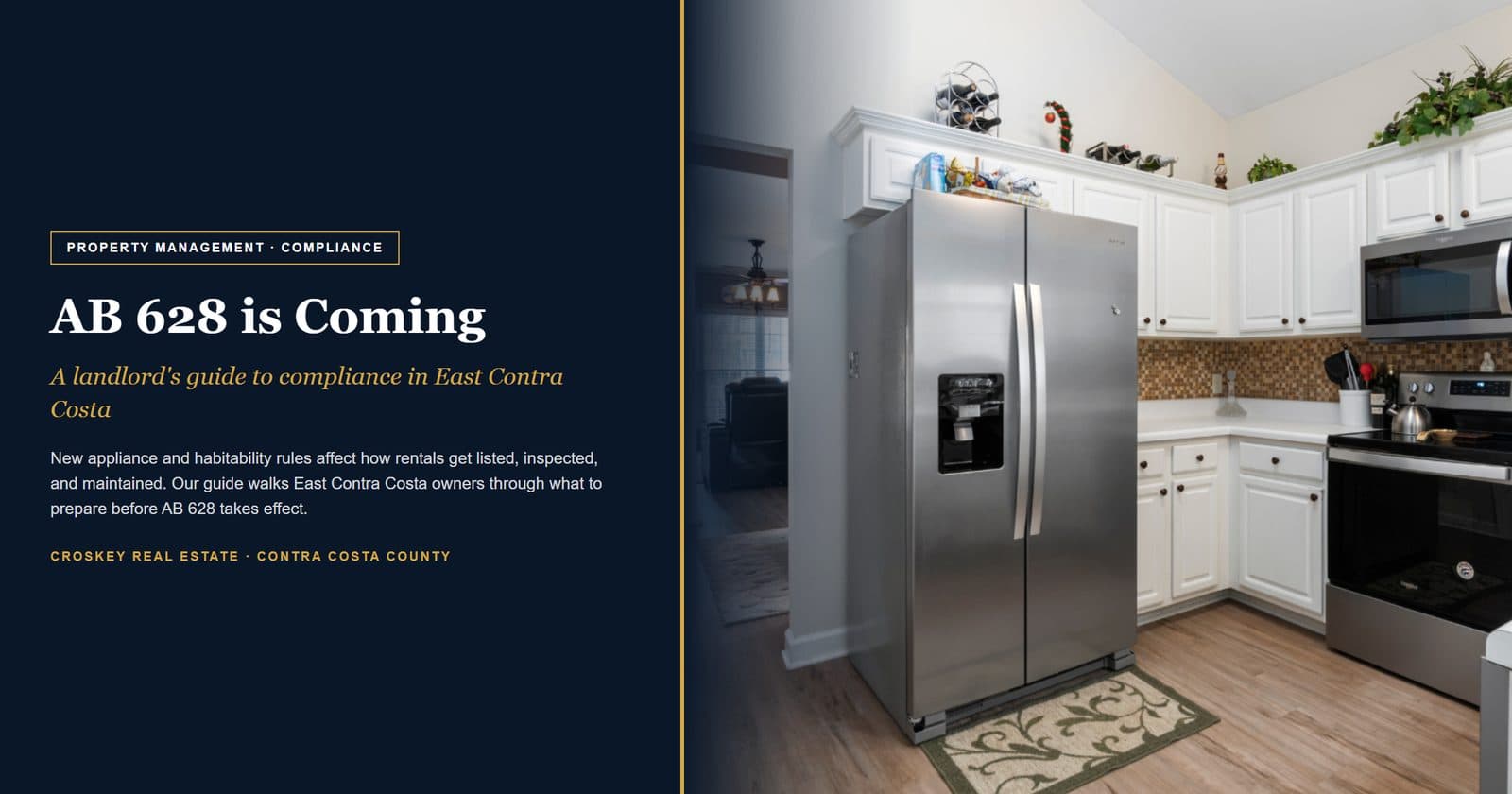
A California rental now has to come with a working stove and refrigerator, the same way it has to come with heat and running water. That is AB 628, live since January 1, 2026, and it reaches each property as its lease is signed, amended, or renewed, which makes it a renewal-calendar problem for housing providers (landlords) rather than a single deadline. For owners in Pittsburg, Antioch, Oakley, and the rest of East Contra Costa, the question is not whether it applies but what it changes about the next renewal. And if you want AB 628 in context with everything else that changed this year, our California landlord laws guide keeps the whole rulebook in one place.
What is AB 628?
AB 628, authored by Assemblymember Tina McKinnor, amends California’s Civil Code §1941.1 to include a working stove and refrigerator as essential components of a habitable dwelling. Effective for all new, amended, or renewed leases starting January 1, 2026, this law mandates that landlords must provide these appliances in good working order. Previously considered amenities, stoves and refrigerators are now legally defined as necessities, placing them in the same category as heating and running water. This change significantly expands landlord responsibilities and creates new legal risks for non-compliance.
“Landlords cannot have occupants in a rental without a refrigerator just like they can’t have you in there without hot running water or a heater,” explained Assemblymember McKinnor, highlighting the bill’s intent to modernize living standards for California tenants [1].
The impact on East Contra Costa landlords
East Contra Costa County, with its diverse mix of urban and suburban communities like Antioch, Pittsburg, and Oakley, presents a unique set of challenges for AB 628 compliance. The region’s housing market, dominated by single-family homes (67% of the housing stock) and a significant number of rental properties (over 135,000 renter households), means that many small-scale landlords will be directly affected by this new law [2].

These factors combine to create a compliance landscape where proactive planning and strategic investment are essential for success. Landlords who fail to prepare for AB 628 risk legal penalties and a loss of competitiveness in the evolving East Contra Costa rental market.
Three steps to prepare
To navigate the complexities of AB 628, East Contra Costa landlords should take the following three steps:
1. Conduct a property and financial assessment
The first step is to conduct a thorough inventory of your rental properties to determine which units will require new appliances. This assessment should include an evaluation of existing electrical and plumbing systems to identify any necessary upgrades. Once you have a clear understanding of your property needs, you can develop a detailed budget for appliance purchases, installation, and any required renovations. Industry data suggests that landlords should budget approximately $1,200 to $2,000 per unit for a basic refrigerator and stove, with additional costs for installation and potential infrastructure work [3].
2. Update lease agreements and documentation
With the January 1, 2026, deadline approaching, it is crucial to update all lease agreements to reflect the new habitability standards. Your leases should clearly state that a working stove and refrigerator are included as part of the rental agreement and outline the procedures for maintenance and repairs. This is not merely a suggestion; it is a legal necessity. A malfunctioning appliance can now be used as a basis for habitability disputes, rent withholding, and even as a defense in eviction proceedings. Implementing a robust system for tracking appliance maintenance and replacement schedules is also essential for mitigating legal risks.
3. Build the implementation plan
Rather than waiting until the last minute, a phased implementation approach will allow you to spread out costs and manage the transition more effectively. Prioritize properties with upcoming lease renewals or new tenant placements. This will give you the opportunity to test different appliance models, establish relationships with reliable suppliers and installers, and refine your maintenance protocols. Early compliance can also be a powerful marketing tool, allowing you to attract high-quality tenants and potentially command higher rents.
The bigger picture: beyond compliance
While AB 628 presents a new set of challenges, it also offers an opportunity for landlords to enhance the value of their properties and improve their market position. By investing in quality appliances and proactively managing compliance, you can create a more desirable living experience for your tenants, leading to lower vacancy rates and a more stable rental income. In the long run, embracing these new standards can be a strategic investment in the future of your rental business.
Our read, from the operator’s chair
The refrigerator that dies on a Friday has always been one of our least favorite calls; AB 628 turns it from a courtesy sprint into a habitability clock. Managing East Contra Costa rentals, the change we made is simple: every unit’s stove and refrigerator now live on the same inventory as the furnace and the water heater, with age, condition, and a replacement plan, because an appliance that was an amenity under the old lease becomes a legal necessity the day that lease renews. Owners who budget the swap at renewal are buying compliance on their own calendar instead of the tenant’s.
This guide is general information about California law, not legal advice; confirm compliance questions for your property with a qualified professional. Croskey Real Estate is an Equal Housing Opportunity provider. DRE #01990430.
Frequently asked questions
What does AB 628 require California landlords to do?
AB 628 updates California's habitability standards for residential rental properties. Landlords must ensure their units meet the updated requirements covering structural safety, weatherproofing, plumbing, heating, and related conditions. Properties that fail to meet these standards may be subject to enforcement action.
Does AB 628 apply to rental properties in East Contra Costa County?
Yes. AB 628 is a statewide California law that applies to all residential rental properties in the state, including properties in Pittsburg, Antioch, Brentwood, Oakley, Bay Point, and Concord. Local code enforcement can take action on properties that do not meet the updated standards.
What is the best way for landlords to prepare for AB 628 compliance?
Schedule a property condition assessment before enforcement begins. A professional inspection identifies any habitability deficiencies while you still have time to address them proactively. Documenting the current condition of the property also creates a defensible record if any compliance questions arise later.
What happens to California landlords who do not comply with AB 628?
Non-compliant landlords may face code enforcement citations, fines, and orders to remediate deficiencies within a specified timeline. In serious cases, local jurisdictions can declare a property substandard, which may require tenant relocation at the landlord's expense and restrict re-leasing until corrections are made.
Sources