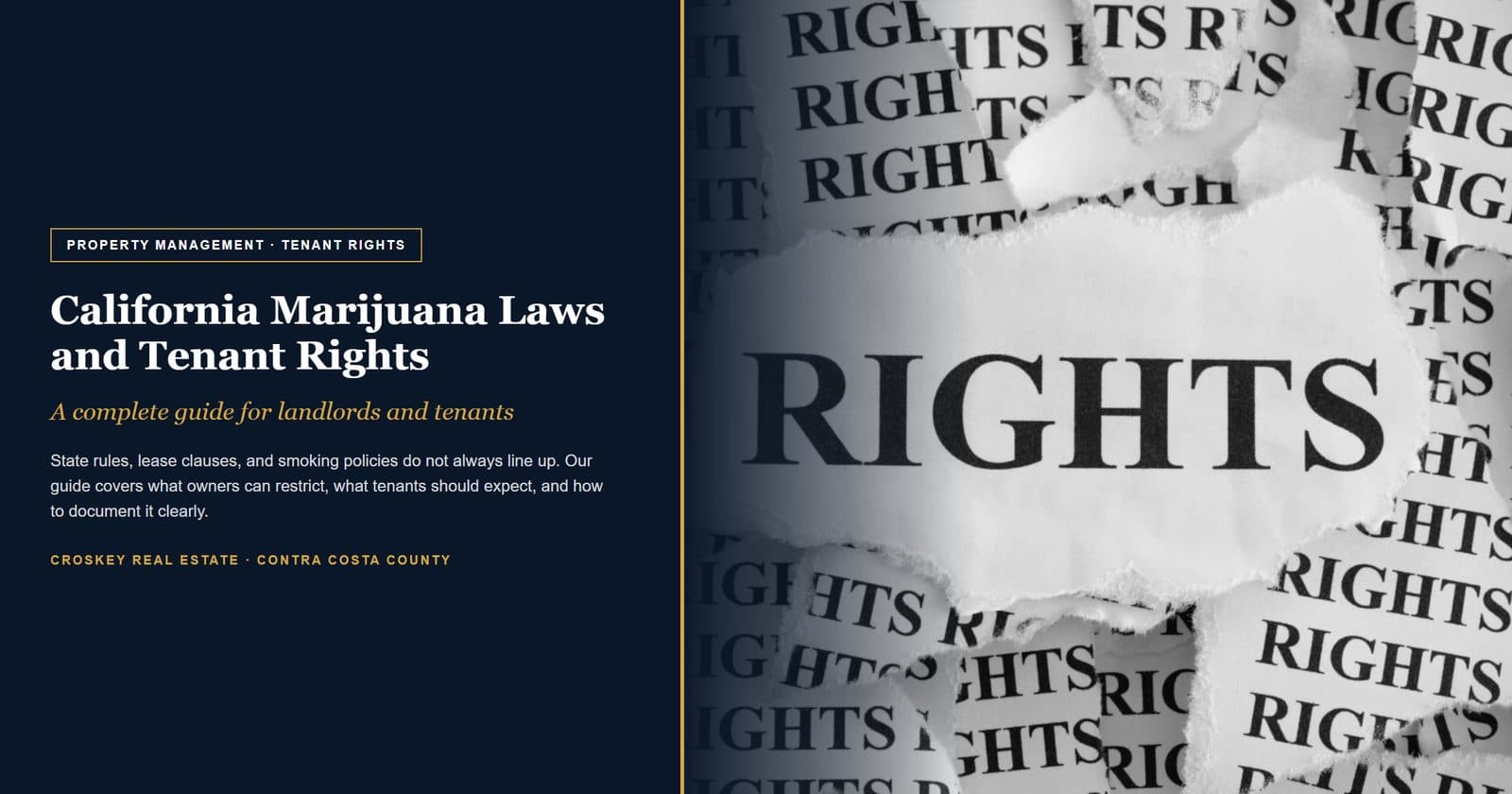
Can a tenant smoke weed in a California rental? Only if the lease allows it. Recreational cannabis is legal in the state, but the law that legalized it also preserved every property owner’s right to prohibit use and cultivation on their property, so the real answer lives in the lease, not the statute. That one sentence settles most of the arguments; the details, from medical requests to federal rules, are where housing providers (landlords) and tenants both get surprised.
Is marijuana legal in California?
Yes, under Proposition 64, also known as the Adult Use of Marijuana Act, adults 21 and over can:
- Possess up to 28.5 grams of cannabis
- Use marijuana in private residences
- Grow up to six plants per household
However, legalization does not override lease agreements or landlord policies.
Can landlords ban marijuana use in rental properties?
Yes. Landlords in California can legally restrict or prohibit marijuana use on their property.
Landlords may:
- Ban smoking or vaping marijuana indoors
- Prohibit cannabis cultivation
- Enforce drug-free housing policies through lease terms
One key reason is that marijuana remains illegal under the Controlled Substances Act, which allows landlords to enforce restrictions, even in a state where cannabis is legal.
Tenant rights for marijuana use in California
Tenants have limited rights when it comes to marijuana use.
Tenants can:
- Legally possess marijuana
- Use cannabis in private if permitted by the lease
Tenants cannot:
- Ignore lease terms that prohibit marijuana
- Smoke in non-smoking units or shared spaces
- Assume legalization guarantees unrestricted use
Medical marijuana and fair housing protections
Medical marijuana introduces additional legal considerations, but not absolute protection.
Under California’s Compassionate Use Act, patients may legally use cannabis for medical purposes. However, housing protections are governed by:
- The Fair Housing Act
- The Fair Employment and Housing Act
Important legal nuance:
- Disability laws require landlords to consider reasonable accommodations
- But marijuana use itself is not automatically a protected accommodation
What landlords must do:
- Evaluate requests on a case-by-case basis
- Engage in an interactive process with the tenant
- Consider reasonable alternatives where appropriate
What landlords are generally NOT required to allow:
- Smoking marijuana (especially if it violates lease terms)
- Activities that create health, safety, or nuisance issues
ADA and housing: what applies?
The Americans with Disabilities Act (ADA) is often misunderstood in housing contexts.
- ADA primarily applies to public and common areas of properties
- Tenant rights inside rental units are mainly governed by fair housing laws
This distinction is important when evaluating disability-related requests involving marijuana.
Can tenants be evicted for marijuana use?
Yes, if marijuana use violates the lease or creates problems.
A landlord may evict a tenant for:
- Violating a no-smoking or no-drug policy
- Causing nuisance (e.g., strong odors, complaints from neighbors)
- Illegal distribution or excessive cultivation
Important:
Evictions must still comply with fair housing laws and cannot be discriminatory.
Fair housing considerations for landlords
To remain compliant, landlords should:
- Apply rules consistently to all tenants
- Avoid blanket denials of disability-related requests
- Document accommodation discussions
- Consider alternatives (e.g., non-smoking forms like edibles)
Failing to follow fair housing requirements can lead to legal risk, even if marijuana itself is restricted.
Can landlords allow marijuana?
Yes, landlords can choose to allow cannabis use under specific conditions.
Some may:
- Permit non-smoking consumption (such as edibles)
- Allow use inside units but not in common areas
- Set clear guidelines instead of a full ban
Everything depends on the lease and property policies.
Our read, from the operator’s chair
Managing rentals across Pittsburg, Antioch, and East Contra Costa, the cannabis questions we field most are practical, not philosophical: smoke complaints from neighboring units, odor at turnover, and grow setups discovered at inspections. The pattern that prevents nearly all of them is a clear written lease: prohibit smoking of any substance on the property, address cultivation explicitly, and apply the same rules to every tenancy. California's legalization law expressly preserves a property owner's right to prohibit cannabis use and cultivation on their property, so the lease, not the statute, is where your policy lives.
For housing providers: restrict use and cultivation through the lease, apply rules uniformly, and evaluate any disability-related accommodation request individually and carefully rather than with a blanket answer.
For tenants: legalization did not override your lease. Review it before assuming anything is permitted, and put accommodation requests in writing.
Cannabis rules are one corner of a rulebook that changes every year; our California landlord laws guide keeps the whole of it, from the rent cap to the new 2026 duties, in one place.
Sources
- Health and Safety Code Section 11362.1 (Proposition 64, adult use)
- Health and Safety Code Section 11362.45 (property owners' rights preserved)
Frequently asked questions
Can California landlords ban marijuana smoking in rental properties?
Yes. California landlords can prohibit smoking of any kind, including marijuana, in the rental unit and on the property. This restriction must be included in the written lease or rental agreement. A no-smoking clause that covers tobacco also covers marijuana unless the lease specifies otherwise.
Can tenants use marijuana legally in a California rental property?
Adult recreational marijuana use is legal in California, but tenants' ability to use cannabis in a rental unit depends on the lease terms. If the lease prohibits smoking or marijuana use, a tenant who violates those terms can face a lease violation notice. Landlords cannot prohibit edible or non-smoking consumption methods unless the lease specifically addresses them.
Can a California landlord evict a tenant for marijuana use?
A landlord can evict a tenant for violating a no-smoking or no-marijuana clause in the lease after serving the appropriate notice to cure or quit. However, evicting a tenant who uses marijuana for medical purposes may raise fair housing concerns if the tenant has a qualifying disability. Consult a property management attorney before proceeding.
Can a California landlord ban marijuana growing in a rental unit?
Yes. Landlords can prohibit marijuana cultivation in the lease. California law allows personal cultivation of up to 6 plants indoors, but that right is subordinate to a landlord's lease prohibition. If the lease bans cultivation and a tenant grows plants anyway, that is a curable lease violation.
Does federal law affect marijuana rules in California rental properties?
Yes. Marijuana remains a Schedule I controlled substance under federal law. Landlords who have federally backed mortgages (FHA, Fannie Mae, Freddie Mac) or federally subsidized tenants (Section 8/HCV) must comply with federal drug-free housing requirements, which means prohibiting marijuana use and cultivation regardless of California state law.
Sources