
Owning a California rental does not come with a key you can use whenever you like. Once a resident moves in, a housing provider or property manager may enter only for the reasons Civil Code section 1954 lists, and the one most owners assume is on the list, the general routine inspection, is not there. For almost everything else you will need written notice that says when you are coming and why: give it 24 hours ahead and the law presumes that is reasonable, or six days if you send it by mail.
That is the whole rule. Everything else is why it works that way, and where the procedure has to bend.
Why this catches owners off guard
Most rental owners assume that because they own the property, they or their manager can periodically go look at it. The assumption is reasonable. It is also wrong.
Once a resident takes possession, the owner still holds title, but the resident holds the legal right to possession. California Civil Code section 1927 obliges the owner to secure the resident's quiet possession of the home for the term of the tenancy. That covenant is what limits entry. It is not a courtesy, and it does not depend on the lease saying anything about it.
So the owner, the manager, vendors, contractors, photographers and appraisers cannot enter simply because the owner would like reassurance, or because a periodic inspection sounds like careful management.
This does not make proactive management impossible. It makes it purposeful. Every entry into an occupied home has to attach to a recognized reason, carry proper notice, and stay within the scope of that reason.
What Civil Code section 1927 actually says
The covenant of quiet enjoyment in California is one sentence, unchanged since 1872: "An agreement to let upon hire binds the letter to secure to the hirer the quiet possession of the thing hired during the term of the hiring, against all persons lawfully claiming the same" (Civil Code section 1927). In a residential tenancy, the letter is the housing provider, the hirer is the resident, and the thing hired is the home: every lease in the state carries this promise whether or not it is written down. The covenant is what makes entry a regulated act rather than an owner’s prerogative. Section 1954 exists to say when the promise of quiet possession yields, and section 1927 is why the default is that it does not.
Quiet enjoyment is about interference, not noise
Quiet enjoyment does not promise a resident silence. It protects the resident's use and occupancy of the home from improper interference by the owner or the owner's agents.
Owner concerns about condition are legitimate. You carry the cost when a slow leak goes unreported, when an unauthorized alteration appears, when landscaping dies, when a pet damages flooring. Those risks are real and they are yours.
California law does not dismiss those concerns. It channels them. Section 1954(c) is explicit that an owner may not abuse the right of access or use it to harass the resident. An entry that is technically noticed but functionally a pretext, or one repeated often enough to disrupt the household, can still be a problem even when the stated reason looks valid on paper.
The reasons the statute actually allows
Civil Code section 1954(a) permits entry into an occupied unit only in these cases:
- In an emergency.
- To make necessary or agreed repairs, decorations, alterations or improvements; to supply necessary or agreed services; to exhibit the unit to prospective or actual purchasers, mortgagees, tenants, workers or contractors; or to make an inspection under Civil Code section 1950.5(f).
- When the resident has abandoned or surrendered the premises.
- Pursuant to a court order.
- For the purposes set out in Chapter 2.5 of the Civil Code, beginning at section 1954.201, which governs submetered water service in multifamily buildings.
- To comply with Health and Safety Code Article 2.2, beginning at section 17973, which is the exterior elevated element inspection requirement covering balconies, decks and walkways in buildings of three or more units.
Two notes on that list, because both are commonly misstated.
The last two grounds are narrow. Water submetering applies to multifamily buildings that submeter, and the balcony inspection ground applies to buildings of three or more units. Neither reaches a single-family rental. If you own a house rather than a building, grounds 1 through 4 are your universe. We cover the balcony requirement separately in our SB 721 inspection guide.
And the initial inspection referenced in ground 2 is a specific, end-of-tenancy event tied to the security deposit, not a mid-lease visit. We cover it in our California security deposit guide.
How much notice is required before entry?
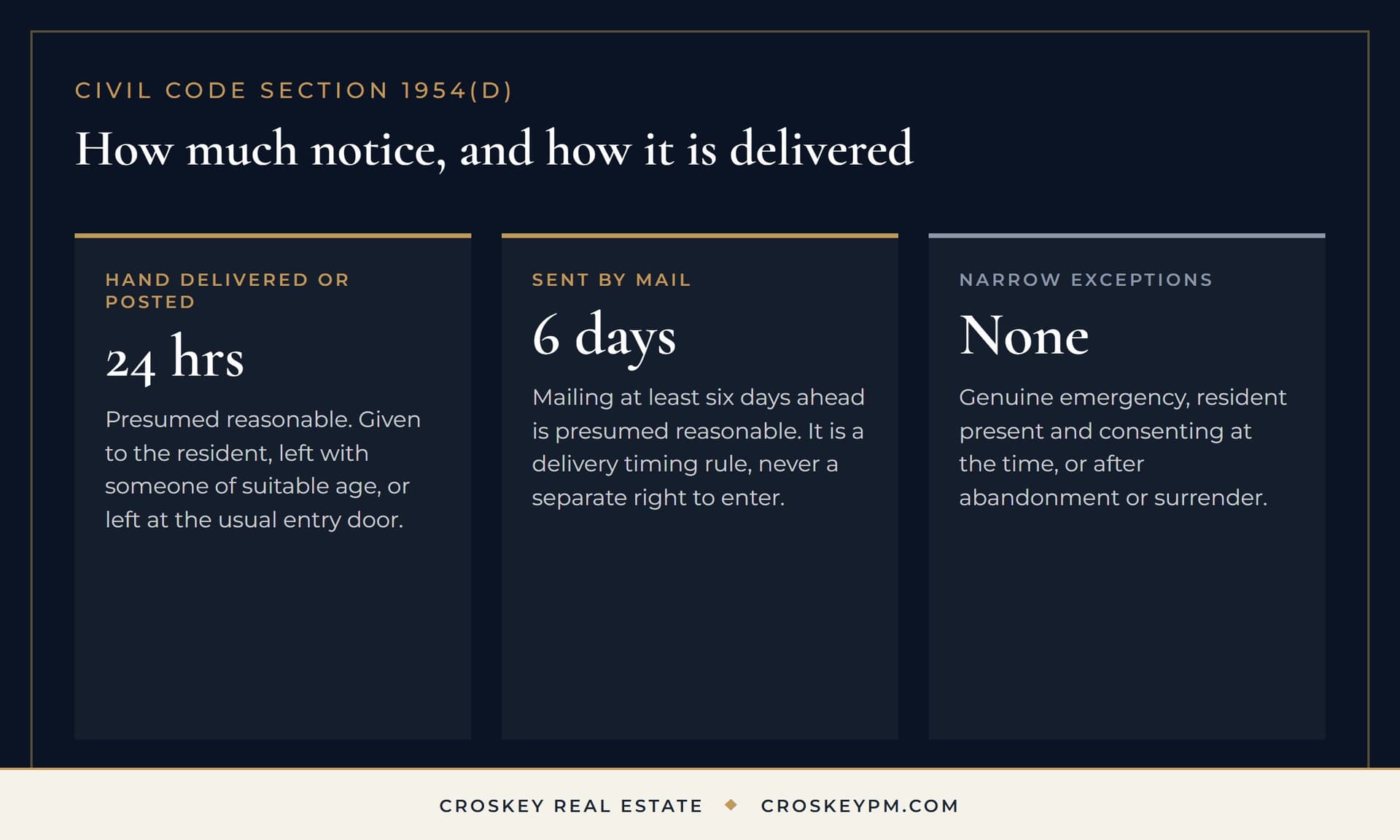
Written notice is the default. For most non-emergency entries, the owner must give reasonable written notice stating the date, approximate time and purpose of entry. The notice may be handed to the resident, left with someone of suitable age and discretion at the property, or left on, near or under the usual entry door in a way a reasonable person would find it.
Twenty-four hours is presumed reasonable. That presumption can be rebutted, which is why the number is a floor for ordinary situations and not a guarantee in unusual ones.
Six days applies to mail. If the notice is mailed, mailing at least six days before the intended entry is presumed reasonable. This is the number owners most often misunderstand. It is not a separate permission to inspect and it does not create a stronger right. It is simply what mailed delivery costs you in lead time, which is why hand delivery or door posting is the practical choice when timing is tight.
Entry happens during normal business hours. Outside those hours, entry requires the resident's consent given at the time of entry. A clause in a lease agreeing in advance to evening access does not satisfy this.
Oral notice works in two narrow situations. First, when the resident and the owner orally agree to entry for agreed repairs or agreed services, provided the agreement fixes the date and approximate time and the entry happens within one week. Second, when the purpose is showing the unit to prospective or actual purchasers, but only if the resident was notified in writing within the previous 120 days that the property is for sale and that the owner or agent may call to arrange showings. In that sale situation there is an extra step that is easy to miss: at the time of entry, the person entering must leave written evidence of the entry inside the unit.
No notice is required in a genuine emergency, when the resident is present and consents at the time, or after the resident has abandoned or surrendered the unit. Each of these is narrower than it sounds. An unreachable resident is not an abandoned unit. A repair you would prefer to handle today is not an emergency.
Grounds that qualify
| Ground | Notice normally required | What it covers |
|---|---|---|
| Emergency | None | Active leak, fire, gas odor, flooding, immediate safety threat |
| Necessary or agreed repairs, decorations, alterations, improvements | 24 hours written, or oral agreement for agreed repairs | Plumbing, HVAC, electrical, roof, appliance and safety work |
| Necessary or agreed services | 24 hours written, or oral agreement for agreed services | Services the owner must supply or has agreed to supply |
| Showing to prospective or actual purchasers | 24 hours; oral notice only under the 120 day rule, and written evidence left inside the unit | An occupied property listed for sale |
| Showing to mortgagees, tenants, workers or contractors | 24 hours written | Appraisals, lender visits, vendor bids, re-leasing |
| Initial inspection under section 1950.5(f) | Scheduled with the resident, no earlier than two weeks before the tenancy ends | The pre move-out inspection tied to the deposit |
| Resident has abandoned or surrendered | None | After legal abandonment or surrender |
| Court order | As the order directs | Rare, usually a dispute or enforcement matter |
| Water submetering, Chapter 2.5 | As that chapter provides | Submetered multifamily buildings only |
| Exterior elevated element inspection, section 17973 | 24 hours written | Balconies and walkways, buildings of three or more units |
| Resident present and consents at the time | None | The resident lets the vendor in |
Requests that do not qualify
| Request | Status | Why notice does not fix it |
|---|---|---|
| Routine periodic inspection with no repair, service, showing, emergency, court order or move-out purpose | Not an authorized ground | Section 1954(a) is a closed list. Notice is the procedure for a lawful entry, not a substitute for one |
| A look around to see how the resident is living | Not authorized | No statutory purpose, and it is the kind of access section 1954(c) treats as abuse |
| Entry because the owner owns the property | Not authorized | Ownership does not carry possession once the home is rented |
| Entry to pressure or intimidate a resident | Prohibited | Section 1954(c) bars using access to harass |
| Repeated entries, each with a valid reason | Risky | A valid ground can still become abuse of access through frequency |
| Calling ordinary maintenance an emergency to skip notice | Risky | The emergency exception is read narrowly and misuse undermines every later entry |
| Treating an unreachable resident as an abandonment | Not authorized | Late rent and silence are not abandonment or surrender |
Notice is procedure, not permission
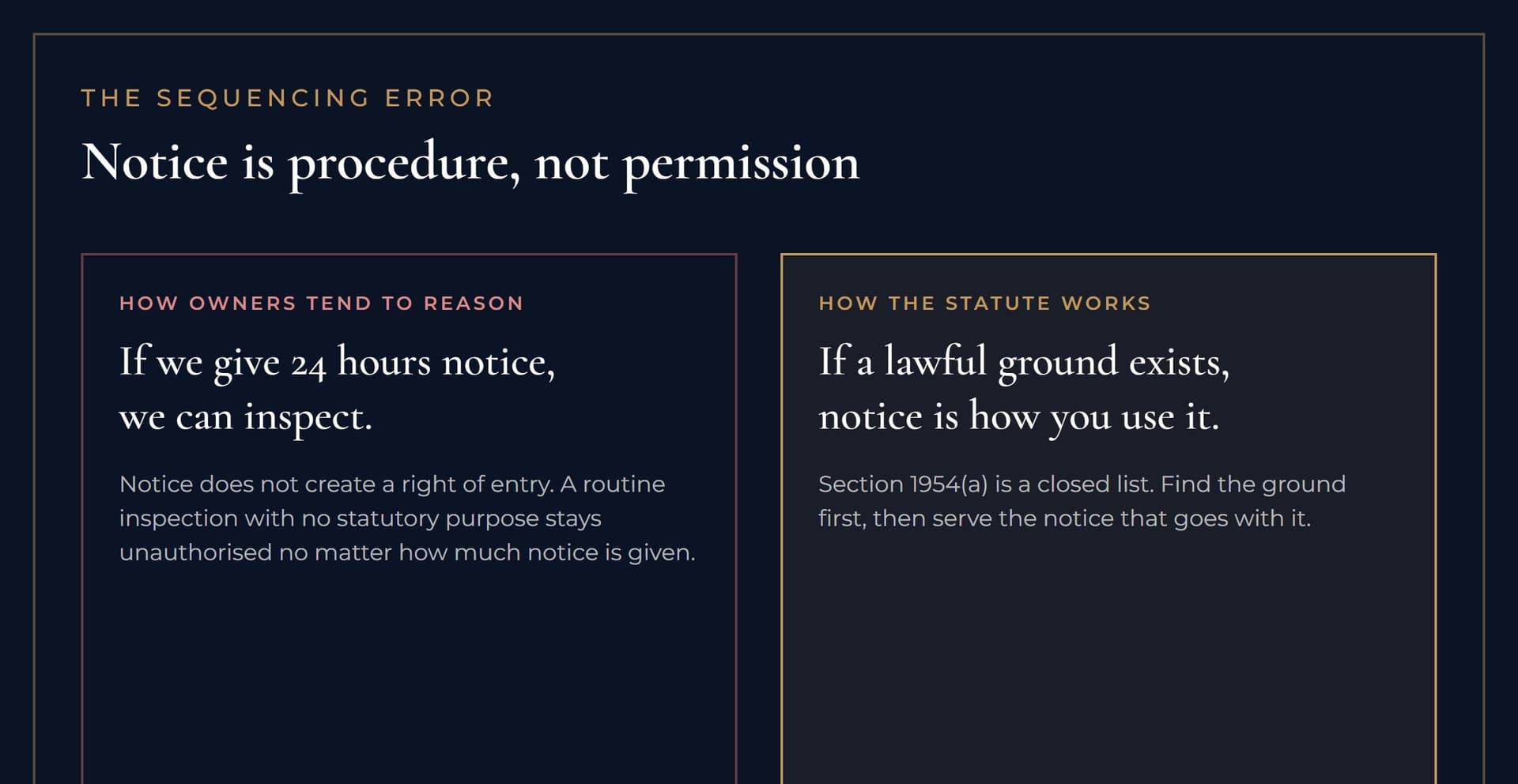
The most common error in this area is a sequencing error. Owners tend to reason:
If we give 24 hours notice, we can inspect.
The statute works the other way around:
If a lawful ground for entry exists, 24 hours written notice is usually how you exercise it.
Notice does not manufacture a right of entry. It is the process attached to a right that already exists. This is why adding more notice to an entry that has no statutory purpose does not rescue it, and why a lease clause promising quarterly inspections does not create an entry right the statute withholds.
When fair housing changes the procedure
Everything above describes the default. For a resident with a disability, the default can be required to bend, and this is the part most entry policies leave out.
The governing law here is not the Americans with Disabilities Act. ADA Title III applies to places of public accommodation, which reaches a rental office open to the public but not the rented home itself. The operative laws for housing are the federal Fair Housing Act and California's Fair Employment and Housing Act, along with the Unruh Civil Rights Act.
Under those laws, a housing provider must make reasonable accommodations in rules, policies, practices and services when an accommodation is necessary to give a person with a disability equal opportunity to use and enjoy their home. An entry procedure is a policy. It is therefore subject to accommodation.
In practice that can mean:
- more than 24 hours notice, where a condition or a caregiver schedule requires planning
- limiting entry to particular times of day
- enough advance warning to secure an assistance animal before a vendor arrives
- allowing a support person or family member to be present
- vendor protocols for an immunocompromised resident
The trap worth understanding. A resident who repeatedly declines access may be making an accommodation request without using any of those words. A request does not have to be written, and it does not have to sound legal. If the response is simply to log the refusal and move on, the file that accumulates is a record of a housing provider that was asked for flexibility and never engaged. That record helps a discrimination claim. It does not defend against one.
Documentation remains essential. What has to be documented is not only that access was declined, but what was asked for, what was offered in response, and how the conversation was resolved. That is the interactive process, and it is the difference between a defensible file and a damaging one.
Two related points. Assistance animals are not pets under fair housing law, and a resident may reasonably need notice to secure one before anyone enters. And entering some residents' homes noticeably more often than others, without a purpose-based reason for the difference, is differential treatment regardless of how carefully each individual notice was drafted.
What a purposeful condition assessment looks like
None of this prevents a manager from understanding the condition of a property. It shapes how that understanding is obtained.
A defensible occupied-property visit has five features. It has a specific lawful purpose identified before the visit is scheduled. It carries proper written notice naming that purpose. It is scheduled during normal business hours at a time that works for the household. It stays inside the scope of the stated purpose. And it produces a record of what was observed and what happens next.
For owners, the practical translation is that most condition information arrives through work that was already going to happen. A vendor attending a reported repair sees the water heater. A contractor pricing a fence sees the drainage. A move-out inspection sees everything. A manager who tracks maintenance requests to completion accumulates a far more accurate picture of a property than one who walks through twice a year, and does it without ever standing on shaky legal ground.
For owners in Contra Costa County
Croskey Real Estate manages single-family rentals in Pittsburg, Antioch, Brentwood, Oakley, Bay Point and Concord. Entry rules are state law, so they apply identically across all of them, but local ordinances can add requirements on top, particularly around just cause and tenant protections.
If you own a rental in the area and want the wider legal picture, our California landlord law guide covers the other obligations that sit alongside entry rights.
Our read, from the operator’s chair
The request we decline most often from new owners is the drive-by: just get in there once a quarter and make sure they are not destroying the place. The instinct is understandable, because the home is usually the owner’s largest asset, but entry law is one of the few places where the careful path and the legal path are the same path. So we tie every entry to a ground section 1954 recognizes: the repair with its written notice, the documented condition assessment with a stated purpose, move-out on its own statutory clock. What managing East Contra Costa rentals has taught us is that the owners who most want surprise access are usually the ones whose last surprise was expensive, and the fix is not more entries; it is a rhythm that keeps the unit legible between entries: photos with every work order, residents who report early because reporting works, and an assessment calendar nobody improvises. Quiet possession is not a constraint on good management. It is what good management looks like from the resident’s side of the door.
The bottom line
Occupied rental property is not vacant property. The resident's right to quiet possession limits when and how anyone may enter, and no amount of notice converts an unauthorized purpose into an authorized one. Tie every entry to a recognized ground, give proper written notice, schedule reasonably, stay within the stated purpose, document what you find, and treat an unusual request as a possible accommodation rather than an obstacle.
That protects the property, protects the owner, and keeps the relationship with the resident intact, which is usually the cheapest form of risk management available.
Move-out is the one entry scenario with its own statutory sequence. How the initial inspection, its 48 hour written notice, and the photograph rules fit together is covered in our move-in and move-out inspections guide.
If you would rather the grounds, the notices and the documentation simply happen on schedule, that is the job: schedule a call and we will show you the rhythm we run.
This guide is general information about California law and is not legal advice for any particular situation. Consult an attorney about your specific circumstances.
Frequently asked questions
Can a California landlord enter for a routine inspection?
Not on that basis alone. Civil Code section 1954(a) lists the permitted grounds for entry, and a general routine inspection is not among them. An entry must attach to a recognized purpose such as repairs, agreed services, a showing, an emergency, a court order, abandonment, or the initial inspection under section 1950.5(f).
How much notice does a California landlord have to give before entering?
For most non-emergency entries, reasonable written notice stating the date, approximate time and purpose. Twenty-four hours is presumed reasonable. Entry must occur during normal business hours unless the resident consents to another time at the time of entry.
Does mailed notice of entry require six days?
Mailing the notice at least six days before the intended entry is presumed reasonable. It is a delivery timing rule, not a separate right of access, which is why hand delivery or door posting is usually the practical choice when timing matters.
Can a landlord enter without notice in an emergency?
Yes. A genuine emergency such as flooding, fire, a gas odor or an immediate safety threat justifies entry without advance notice. The exception is narrow and should not be used for ordinary maintenance.
Can a resident refuse entry?
A resident can decline, and the owner’s remedy is not to force the door. Repeated refusal is handled through the lease and, if necessary, legal process. The refusal and the attempts should be documented, together with what the resident asked for and what was offered in response.
Does a resident’s disability change the entry rules?
It can change the procedure. Under the federal Fair Housing Act and California’s Fair Employment and Housing Act, a housing provider must make reasonable accommodations in policies when necessary for a person with a disability to use and enjoy their home. That can mean longer notice, restricted times of day, or time to secure an assistance animal. A request does not have to be in writing or use legal language.
What is the difference between a condition assessment and a routine inspection?
A condition assessment is tied to a defined lawful purpose such as evaluating a reported repair, verifying completed work or documenting a habitability concern, and it stays within that purpose. A routine inspection, described as a general right to look around, is not separately authorized by section 1954 and notice does not cure that.
Sources
- California Civil Code Section 1954 (landlord entry)
- California Civil Code Section 1927 (covenant of quiet possession)
- California Civil Code Section 1950.5 (security deposits and initial inspection)
- California Civil Code Chapter 2.5 from Section 1954.201 (submetered water service)
- California Health and Safety Code Section 17973 (exterior elevated elements)
- California Government Code Section 12955 (Fair Employment and Housing Act)