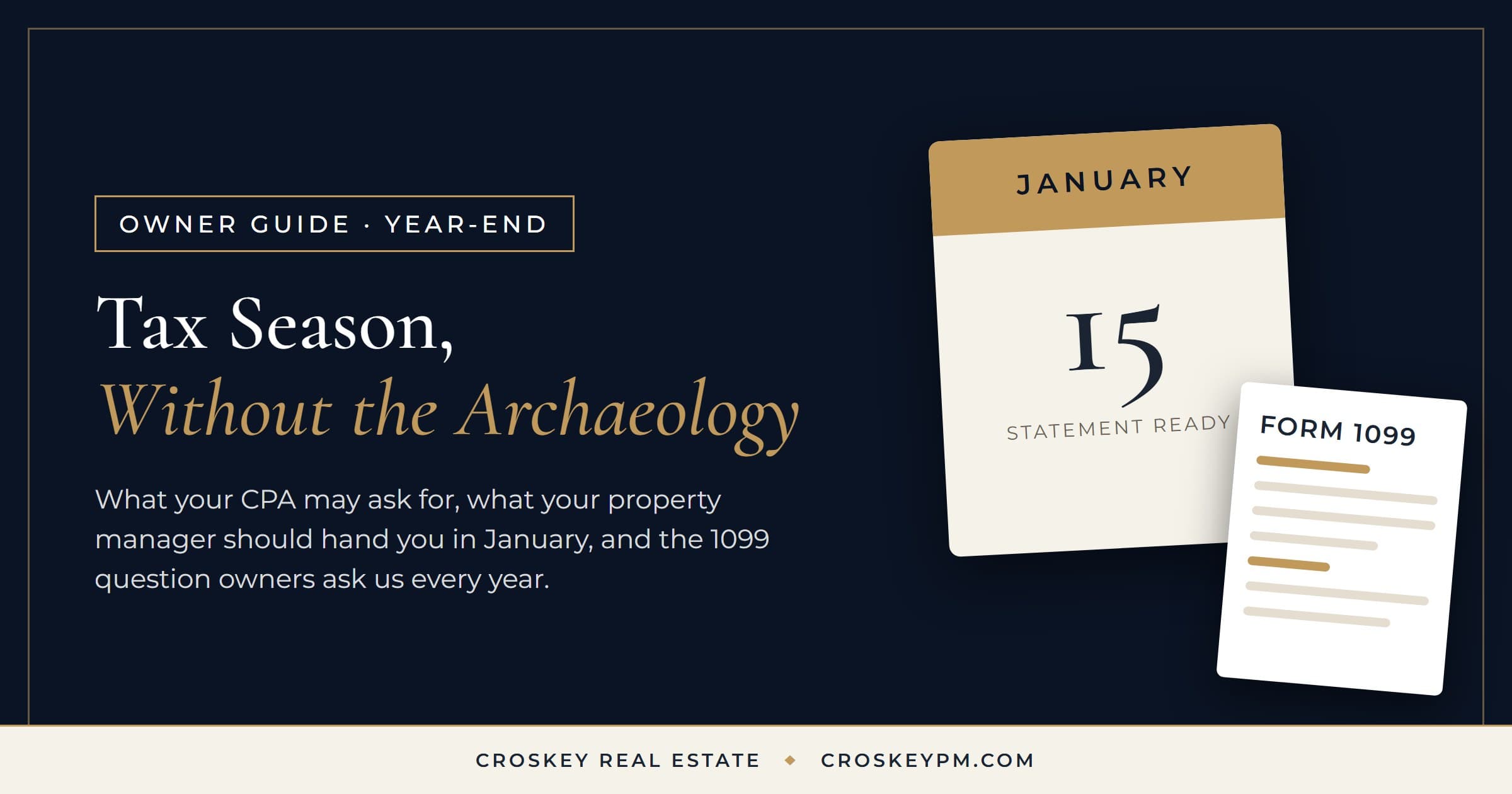
Tax season for a rental property is much easier when the work starts in November and December, not in March. Every January, housing providers across East Contra Costa assemble the same paper trail from their rental year, the CPA asks for the same documents, and the same 1099 question lands in our inbox by the second week.
Common documents your CPA may request for a rental property
- Total rental income collected for the year
- Expenses by category, such as maintenance and repairs, management fees, insurance, property taxes, HOA dues, and owner-paid utilities
- Mortgage interest statement, such as Form 1098, if applicable
- Records that separate repairs from improvements. Your CPA may treat these differently, so flag anything that might be an improvement rather than deciding yourself
- Your 1099 from your property manager, if the property is professionally managed
What your property manager should help provide, and when
A well-run management company should not leave you reconstructing the year from scattered records.
At Croskey, the year-end package includes your IRS 1099 for filing, a year-end financial report showing the property's income and expenses, and supporting owner statements, all available through the owner portal.
The timeline behind that package matters more than owners realize. Our process starts in November and December with expense categorization, vendor W-9 collection, owner statement review, and audit reports. The goal is to have the final 1099 and year-end statement ready around January 15, with 1099s delivered electronically before the IRS deadline at the end of January. Mailed copies are available on request.
If your current manager sends only a 1099 with no supporting year-end reporting, it is fair to ask what financial reporting is included in your management service.
"Why doesn't my 1099 match my year-end statement?"
This is one of the questions we hear most often every January.
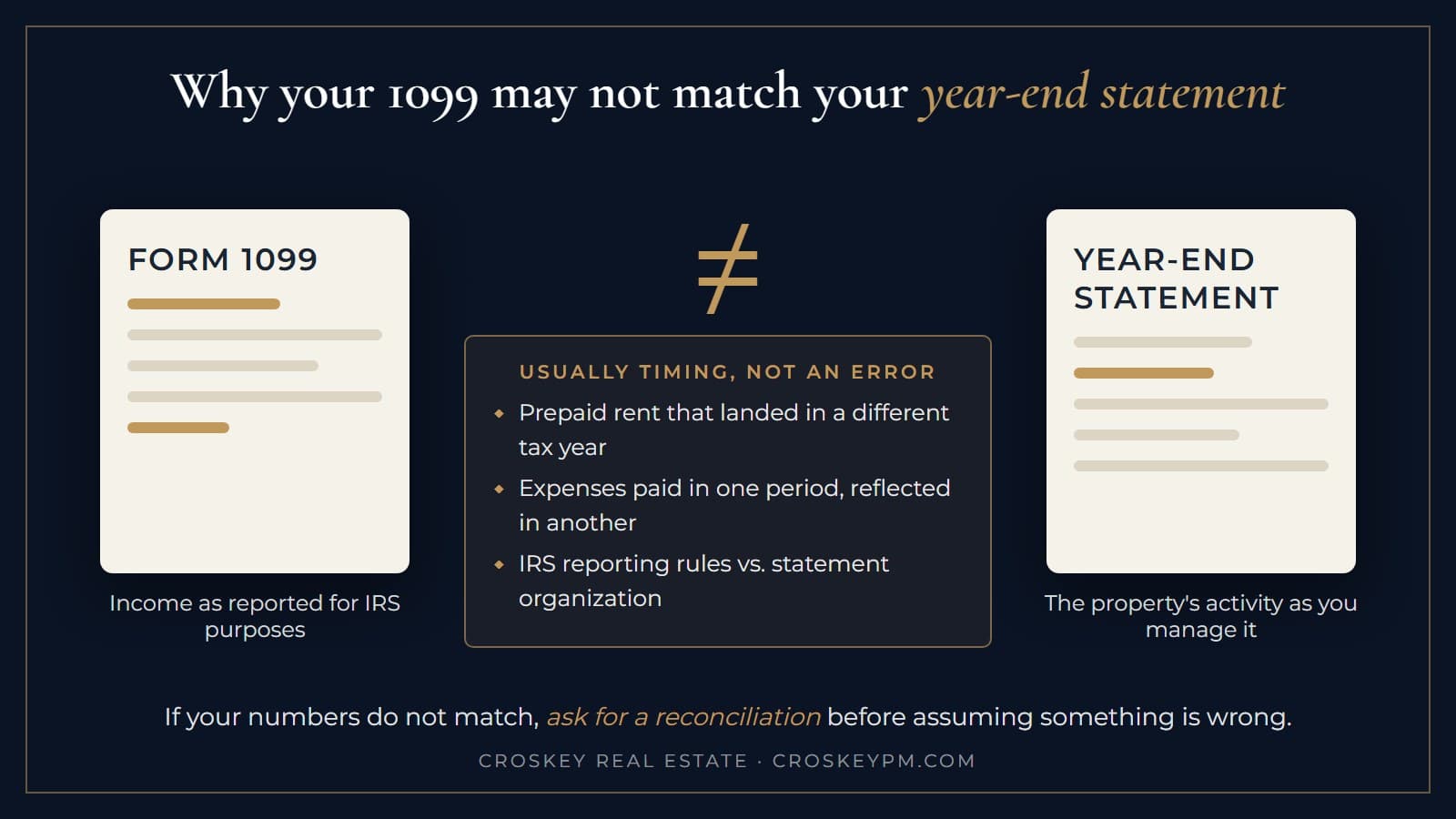
Often, the answer is timing, not necessarily an error. Examples may include prepaid rent that landed in a different tax year, expenses paid in one period but reflected in another, or differences between how income is reported for IRS purposes and how an owner statement organizes the same activity.
When records are clean, the difference is much easier to explain. We can review the statement, provide supporting detail, and, when helpful, walk the owner through the numbers line by line. When records are messy, January becomes a reconstruction project.
If your numbers do not match, ask for a reconciliation before assuming something is wrong.
The calendar that makes March easier
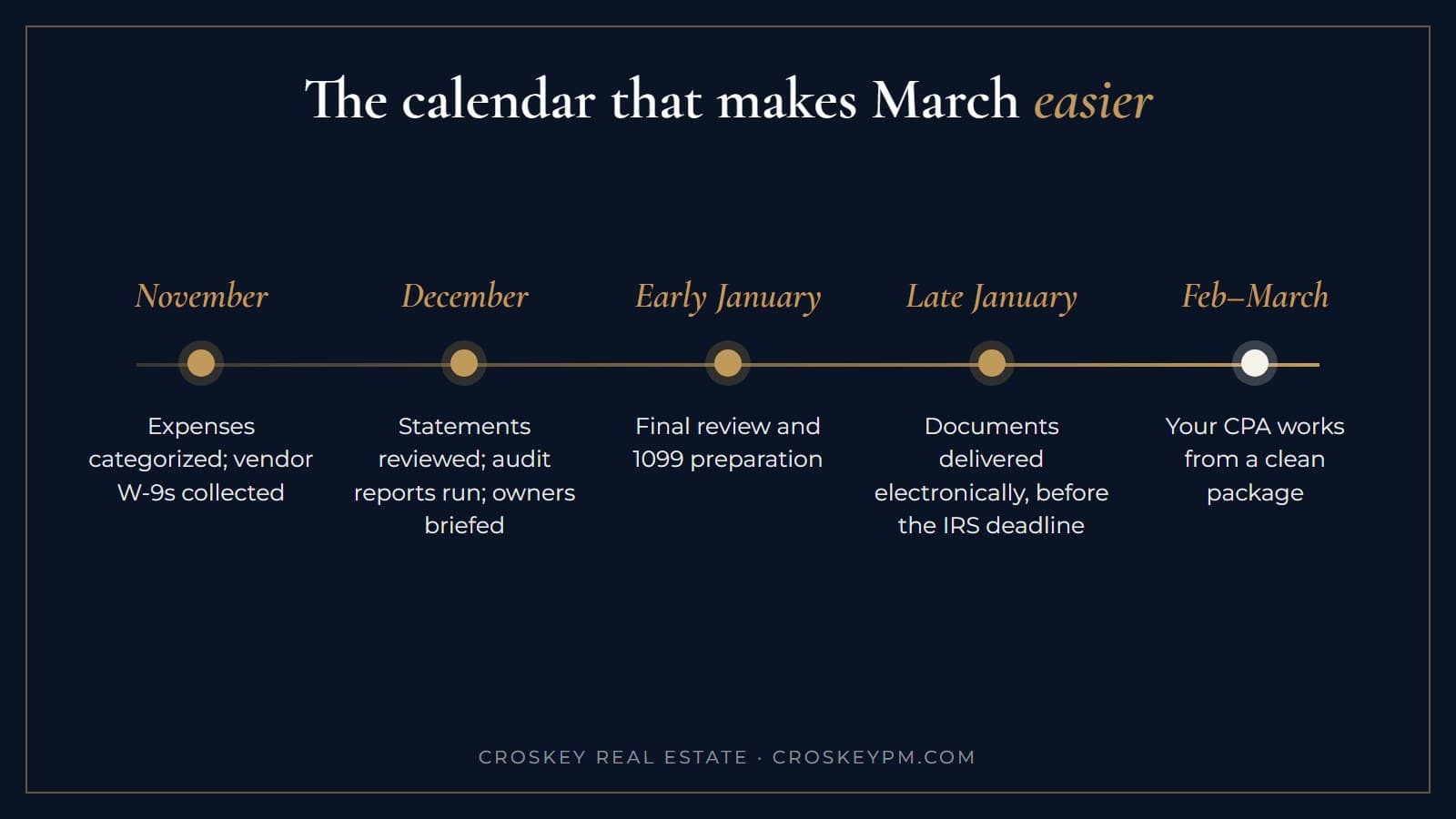
- November: Expenses categorized correctly; vendor W-9s collected
- December: Owner statements reviewed, audit reports run, and owners told what to expect
- Early January: Final review and 1099 preparation
- Late January: Documents delivered electronically
- February-March: Your CPA works from a clean package, and you answer questions instead of hunting for records
If you wait until March to organize your rental property records, you are not doing tax prep. You are doing archaeology.
Our read, from the operator’s chair
The January call we try to make unnecessary is the owner forwarding a CPA email with three question marks in it. Clarity matters as much as the documents themselves.
Our approach is to be proactive before owners ask, keep statements clean and reviewable, make the owner portal the record hub, and explain the line items that confuse everyone before owners have to ask twice.
We provide the reporting. Your CPA provides the tax advice. The best January is the one where those two things meet without friction.
Insurance premiums are commonly part of the documentation your CPA may want to review. Our landlord insurance guide explains how those policies work and what housing providers should understand about coverage.
Sources
Croskey Real Estate is not a CPA firm and does not provide tax advice. Our role is to keep property records clean, organized, and ready so your CPA can do their job with fewer surprises. Confirm all tax questions with a qualified tax professional.
Croskey Real Estate is an Equal Housing Opportunity provider. DRE #01990430.
Frequently asked questions
When will I get my 1099 from my property manager?
Croskey delivers 1099s electronically toward the end of January, before the IRS deadline, with the year-end statement targeted around January 15. A mailed copy is available on request. If your manager cannot give you a clear January timeline, ask what their year-end reporting process looks like.
Why doesn't my 1099 match my year-end statement?
Often, the answer is timing. Prepaid rent crossing tax years, expenses paid versus reflected in different periods, or IRS reporting rules may cause the 1099 and year-end statement to look different. Ask your manager for a reconciliation. With clean records, this should usually be straightforward to explain.
What documents does my CPA need for my rental property?
Common items include income totals, categorized expenses, Form 1098 from your lender if applicable, records separating repairs from improvements, and your 1099 if the property is professionally managed. A professionally managed property should make these records easier to access and review.
Do property managers give tax advice?
No. A property manager's role is to provide clean, organized, reconciled records. Your CPA's role is to provide tax advice and tax strategy based on those records.
What is a 1099 from a property manager?
It is the IRS form a management company issues to a property owner reporting the rental income collected on their behalf during the tax year. It arrives alongside the year-end financial report and owner statements, and your CPA uses it when preparing your return.
When should a rental property owner start tax preparation?
In November and December, not in March. Categorizing expenses, collecting vendor W-9s, and reviewing owner statements before year-end means documents are ready in January and your CPA works from a clean package instead of reconstructing the year.